Why Your Pace Feels Easy and Your Watch Disagrees on Night Runs
Quick Answer: Cooler air lowers cardiovascular strain for the same pace, reduced visual information removes the speed cues your brain uses to estimate effort, circadian body temperature peaks in the early evening improving muscle performance, and GPS accuracy degrades under tree cover and near buildings. Three of those make you genuinely faster; the fourth just makes the number wrong.
You went out easy. It felt easy the whole way. And the watch says you ran your fastest 5k of the month.
Or the reverse — it felt effortless and the pace is a minute slower than usual, which is somehow more confusing.
Both happen, and the mechanisms behind them are worth separating.
How much does the cooler air actually help?
More than most runners credit, and it is the largest single factor in autumn.
Running generates a great deal of heat, and most of it must be dissipated. In warm conditions, a substantial share of cardiac output is diverted to the skin for cooling, which is blood not available to working muscle.
That diversion shows up directly as cardiac drift — heart rate climbing through a run at constant pace. In cool air the drift is far smaller, so the same pace costs fewer beats per minute and feels correspondingly easier.
Research on marathon performance consistently finds optimal temperatures well below what most people find comfortable to stand around in — often cited in the range of 5 to 10C for the elite end of the field, and somewhat higher for slower runners who generate less heat per hour.
Evening temperatures in early autumn frequently sit right in that band, which is a large part of why this is the season when times drop.
Humidity matters as much as temperature. High humidity impairs evaporative cooling, and evening air after a cool day is often drier than the same air at noon.
Why does the effort feel different in the dark?
Because you have lost most of the information your brain uses to judge speed.
Optic flow — the rate at which the visual scene moves past you — is a primary cue for perceived velocity. In darkness, you can see the few metres your light illuminates and very little else.
With reduced optic flow, the brain underestimates speed. You feel slower than you are, which is why the watch so often reports a faster pace than the run felt.
The opposite also happens on unfamiliar dark routes. Increased attentional load — watching for obstacles, uneven ground, kerbs — raises perceived effort even though the physical work is unchanged. Concentration is not free.
Landmarks are doing more than you realise. On a familiar daylight route you track progress against known points and calibrate pace against them constantly. In the dark that reference system is gone, and your internal pacing becomes noticeably less accurate.
The practical consequence is worth stating plainly: if you run by feel in the dark, you will drift, usually faster. If you have an easy run planned, watch the pace rather than trusting the sensation, or the easy run quietly becomes a moderate one — which over weeks is a real driver of accumulated fatigue.

Does the time of day change performance directly?
Yes, and the effect is well established.
Core body temperature follows a circadian rhythm, typically peaking in the late afternoon or early evening. Higher muscle temperature improves muscle contraction speed, enzyme activity, and flexibility.
Multiple performance measures peak in that same window — strength, power output, reaction time, and anaerobic performance among them. Lung function and pain tolerance follow similar patterns.
The effect is modest but real, and it means an evening run genuinely can be faster at the same effort than the identical run at 6am.
The trade-off is the warm-up requirement. Muscles are warmer, but you have also been sitting for most of the day, so hip flexors and thoracic spine are stiff in a way they are not first thing.
And there is a sleep consideration. Hard evening exercise raises core temperature and sympathetic activation, and the evidence suggests finishing at least an hour or two before bed protects sleep quality for most people. Easy evening running appears to affect sleep very little; hard intervals at 10pm are a different matter.
FAQ: Night Running Questions, Answered
Is my GPS less accurate at night?
Not because of darkness — satellite reception is unaffected by daylight. What changes is usually the route. Night runs often shift to lit paths near buildings or under trees, and both cause multipath errors, where the signal bounces before reaching the watch. This produces a scribbled track and a distance that can be wrong by several percent. If your night pace looks strange, check the map trace before drawing conclusions about your fitness.
How much light do I actually need?
Enough to see the ground about four to five metres ahead at your pace. A headlamp around 200 to 300 lumens is sufficient for most paths, and more is often worse — a very bright beam contracts your pupils and makes everything outside the beam invisible. A chest or waist light casts shadows across uneven ground more usefully than a headlamp, because head-height light flattens texture and hides trip hazards. Many runners use both.
Does running in the dark change my form?
Measurably, yes. Runners typically shorten stride and increase cadence in low light, landing more cautiously and with a flatter foot. That is a sensible adaptation to uncertain ground, and it is worth knowing that your dark-route form data is not directly comparable to daylight data.
Should I be worried about visibility to traffic?
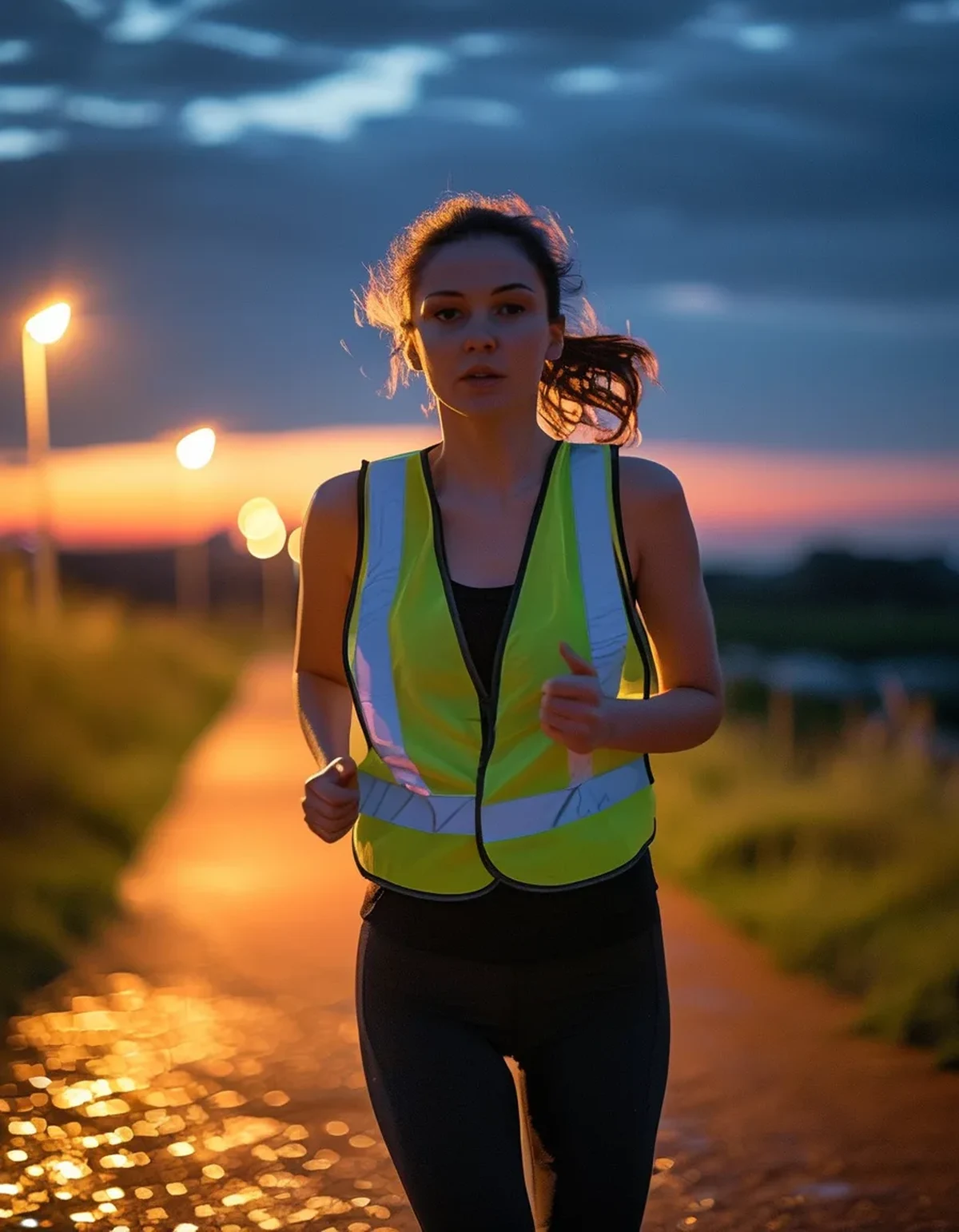
It is the genuine risk of night running and worth taking seriously. Reflective material on moving parts — ankles, wrists — is far more visible than reflective panels on the torso, because motion is what catches a driver’s attention. Add an active light source rather than relying on reflection alone, since reflectives only work when a headlight is pointed at them. Run facing traffic on roads without pavements.
TL;DR:
- Cool air reduces the share of cardiac output diverted to skin cooling, so the same pace costs fewer heartbeats.
- Reduced optic flow in darkness makes you underestimate your speed — easy runs drift faster without you noticing.
- Core temperature peaks in the early evening, genuinely improving muscle performance and reaction time.
- Finish hard evening sessions an hour or two before bed; easy running appears to affect sleep very little.
- GPS errors on tree-covered and building-lined night routes can distort distance by several percent.
- Reflective material on ankles and wrists beats torso panels, and an active light beats reflection alone.
Keep Reading
This article is for general informational and styling purposes only. Fit, sizing, and product availability may vary.