Why Drivers See You Later Than You Think During Dusk Runs
Quick Answer: At twilight, human vision operates in the mesopic range - the transition between daylight cone vision and night-time rod vision - where both systems work poorly. Contrast sensitivity falls, colour perception shifts, and reaction times lengthen, all while drivers still feel like they can see normally. Headlights are not yet effective and ambient light is no longer sufficient. This is why dusk is more dangerous per mile than full darkness. Reflective material only works once headlights are the dominant light source, so at dusk you need something actively lit, not just reflective.
Reflective gear is a night solution. Dusk needs its own.
What is happening to a driver’s vision at dusk?
Cone cells handle daylight and colour; rod cells handle low light and motion. At twilight both are operating below their effective range, which is called mesopic vision.
Contrast sensitivity drops sharply in this range, and detecting a person against a background is fundamentally a contrast task.
Colour perception shifts toward the blue end, which is why reds and oranges - the traditional high-visibility colours - lose effectiveness as light fades. Yellow-green retains visibility longest.
Depth perception and motion detection both degrade, so a driver may see you and still misjudge your speed and distance.
Reaction times lengthen measurably, adding stopping distance at exactly the moment detection is hardest.
And crucially, drivers do not feel impaired. The subjective experience is of seeing normally, which is why speeds do not drop at dusk the way they do in fog or heavy rain.
Why is dusk worse than full night?
In full darkness, headlights are the dominant light source and they work well. Reflective material returns that light directly to the driver and is highly effective.
At dusk, headlights are competing with ambient light and add relatively little, so reflective material has very little to reflect.
Drivers often have not switched their headlights on, or are running daytime running lights only, which produce little usable illumination.
Windscreen glare is at its worst in the low-angle light, and dirt and smears scatter light exactly when contrast is already low.
Dusk coincides with the commute, so traffic volume and driver fatigue are both at their peak.
And the runner also cannot see well - your own mesopic vision makes kerbs, potholes, and vehicle movement harder to judge, so both parties are impaired simultaneously.
What actually makes you visible at dusk?
Active lights, not reflectors. A blinking light is the single most effective item because it produces its own contrast rather than depending on headlights.
Front white and rear red, both blinking. Blinking attracts attention far better than steady in the mesopic range.
Ankle or wrist lights beat torso lights because motion at leg height is uniquely recognisable as a person - drivers identify the movement pattern before they identify the shape.
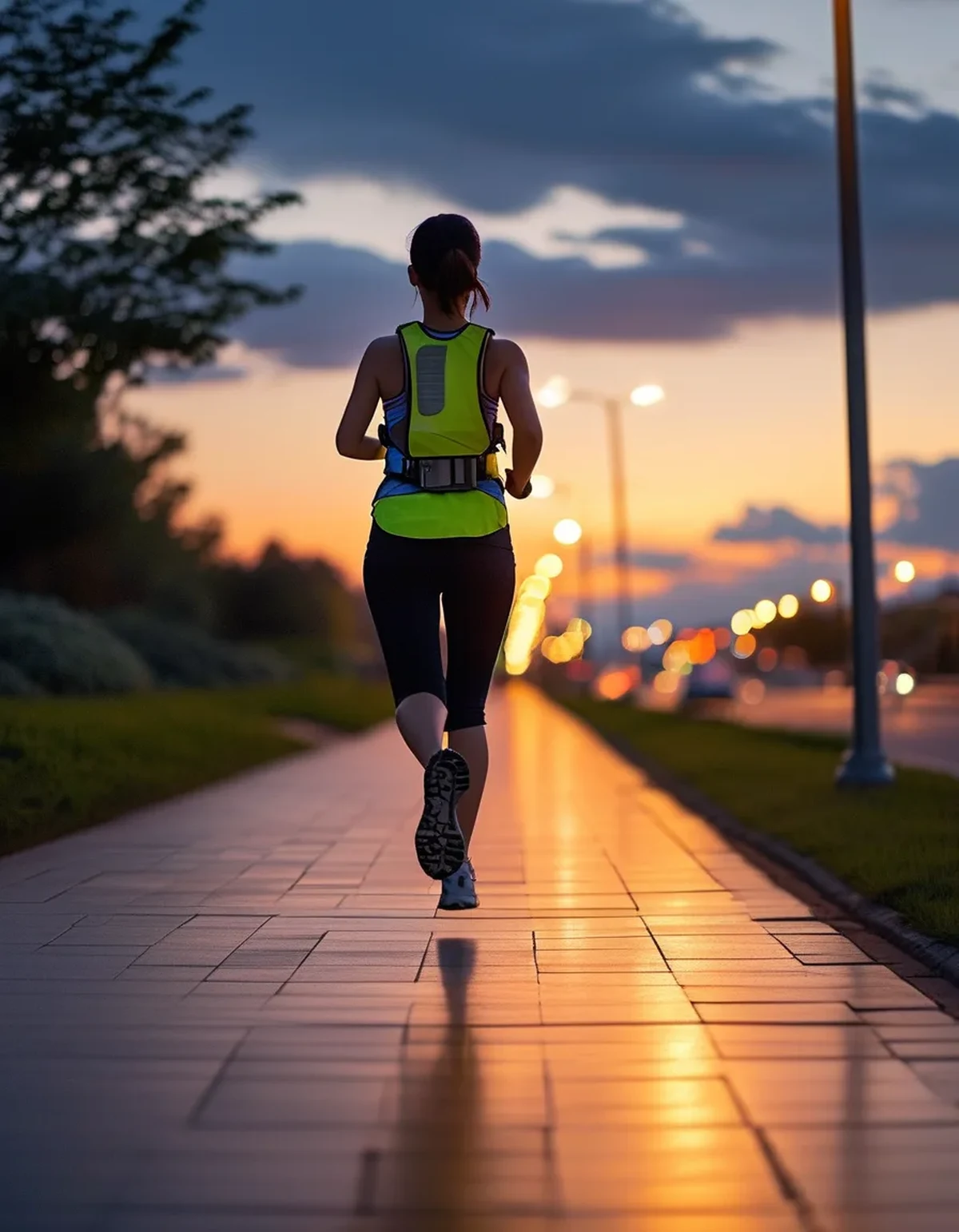
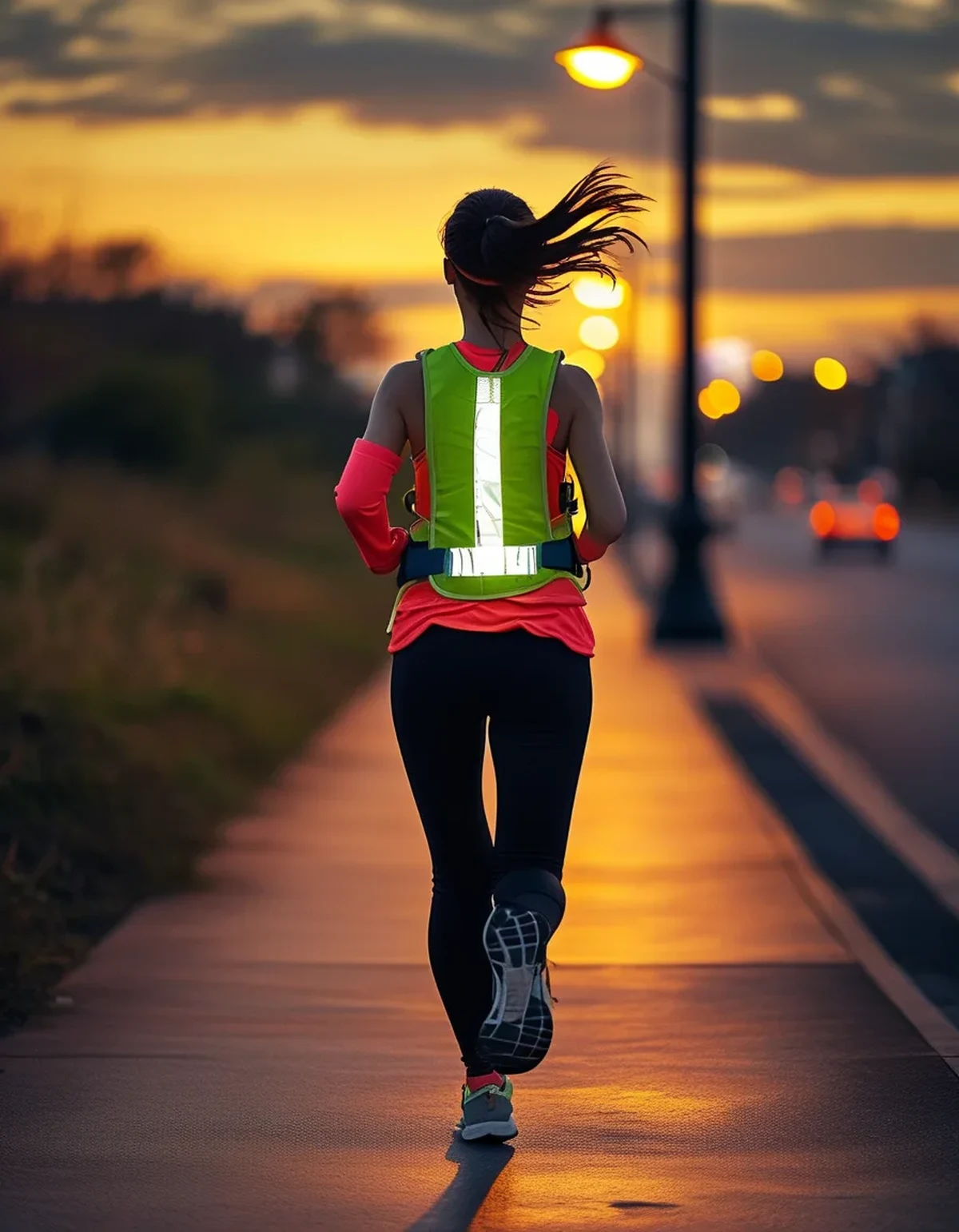
Yellow-green fluorescent fabric outperforms other colours at dusk, because fluorescence uses residual UV in twilight to actively emit rather than reflect. This is the one fabric effect that works before full dark.
Reflective material still belongs on the kit, because dusk becomes night quickly and reflectivity dominates once headlights do.
And more light sources beat one brighter one. Two or three modest lights on different parts of the body communicate size and motion better than a single powerful one.
What Nobody Tells You About Dusk Visibility
Motion at ankle height is the strongest human recognition cue there is. Lights on the ankles produce the distinctive up-down pattern that the visual system flags as a person almost instantly, and it works at greater distance than a torso light.
Black leggings are effectively invisible from the waist down at dusk, which is a problem because that is the part carrying the recognition cue.
Reflective print on dark fabric only works with a direct light source. A jacket covered in reflective detail does nothing at 6:30pm in September and everything at 8pm.
Autumn is the highest-risk period of the year because sunset moves earlier by roughly a minute a day while running habits stay on summer timing - people are suddenly running in twilight without having chosen to.
Wet roads make it dramatically worse. Surface reflection scatters headlight beams and increases glare, cutting effective detection distance substantially.
And assume you have not been seen. Make eye contact at crossings, and treat every turning vehicle as though the driver has not registered you - because at dusk, statistically, there is a good chance they have not.
How should you change the run itself?
Run facing traffic on roads without sidewalks, so you can see approaching vehicles and react.
Move to well-lit routes as the season changes, even if they are less pleasant - route choice does more for safety than any single piece of gear.
Avoid the peak commute window if you can. Shifting a run thirty minutes later moves you from twilight-plus-traffic into darkness-plus-less-traffic, which is a better combination.
Take extra care at junctions and driveways, where turning drivers are scanning for cars rather than people.
Run without headphones, or with one ear open, since hearing is doing more work when vision is degraded.
And check your gear at the start of the season rather than mid-autumn. Batteries die over the summer, and the first dusk run of the year is the one people do unequipped.
FAQ: Dusk Running Safety, Answered
Is dusk really more dangerous than night?
Per mile, yes. Mesopic vision impairs both drivers and runners while headlights are not yet effective, and traffic volume is at its peak.
Is reflective gear enough at dusk?
No. Reflective material needs headlights to work. At dusk you need active lights and fluorescent fabric.
What colour is most visible at twilight?
Yellow-green fluorescent. Reds and oranges lose effectiveness as light shifts toward the blue end of perception.
Where should lights go?
Ankles or wrists first - moving lights at leg height are recognised as a person faster and further away than a torso light.
Blinking or steady?
Blinking for attention in the mesopic range. Some runners use one steady and one blinking to give both attention and position.
Should I change my running time in autumn?
If you can. Shifting later out of the commute window into full darkness with proper lighting is often safer than running in twilight traffic.
TL;DR:
- Dusk puts both drivers and runners in mesopic vision, where contrast sensitivity and reaction time are worst - and drivers do not feel impaired.
- Reflective material needs headlights to work, so it does almost nothing at twilight; you need active lights and fluorescent yellow-green fabric.
- Put lights on ankles or wrists - moving light at leg height is the strongest human-recognition cue there is.
- Autumn is the peak risk period because sunset moves earlier while running habits stay on summer timing.
- Run facing traffic, choose lit routes, keep one ear open, and treat every turning vehicle as though you have not been seen.
Check your lights and batteries at the start of the season, not the week you first get caught out.
Keep Reading
This article is for general informational and styling purposes only. Fit, sizing, and product availability may vary.