Why Headphones Matter More on a Night Run Than a Daytime One
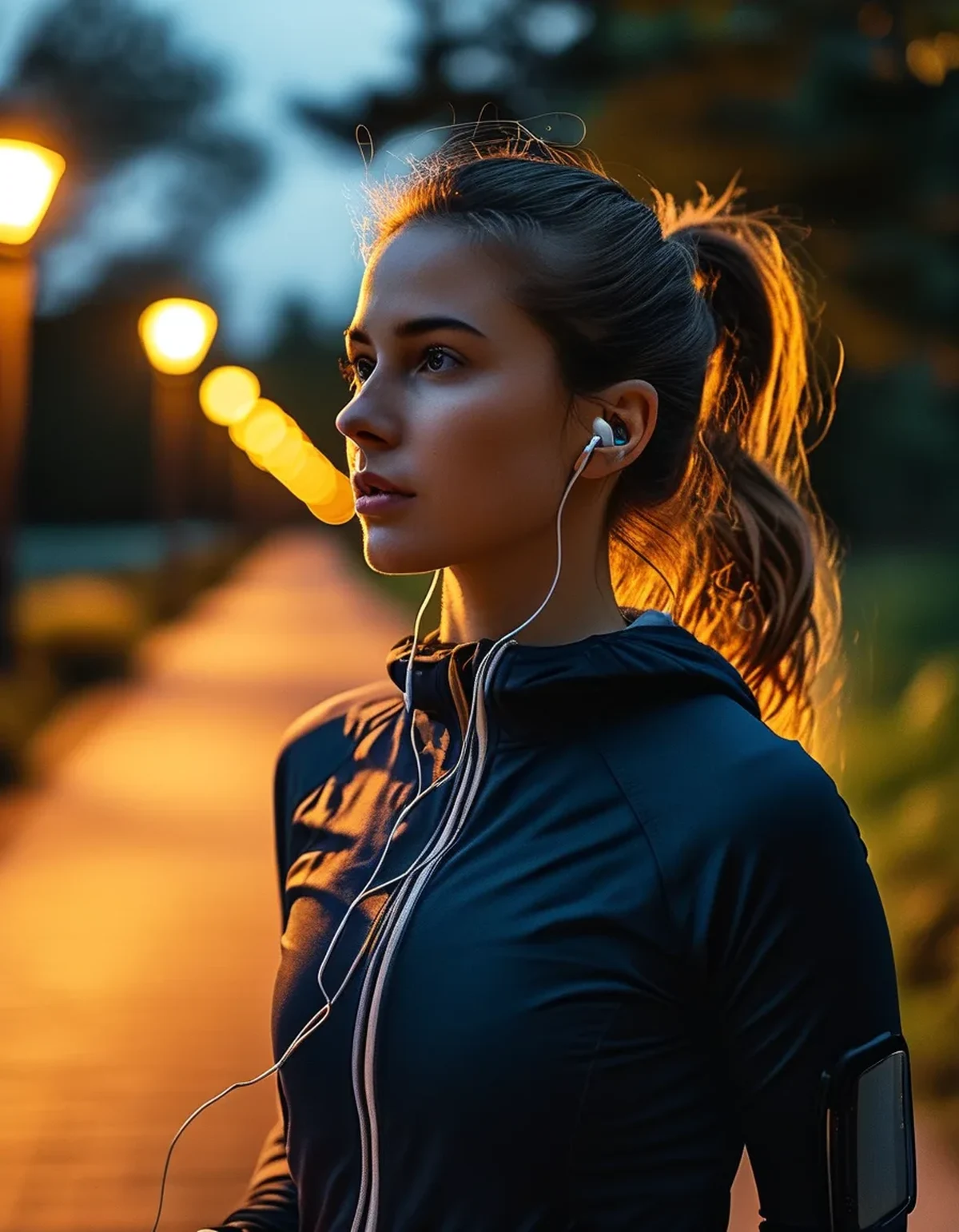
Quick Answer: At night you lose most of your visual information, so hearing carries far more of the load for detecting what is around you. Occluding headphones remove the sense you are now most dependent on, at the time you are most dependent on it. Music also entrains cadence, and in the dark, where you are already running more cautiously, that can push your stride out of step with the surface you cannot fully see. Open-ear or bone conduction designs, or one earbud out, preserve the input you need.
The headphones did not change. What they are blocking did.
That is worth thinking about in autumn specifically, because most people’s daytime runs quietly become night runs over a few weeks without any decision being made.

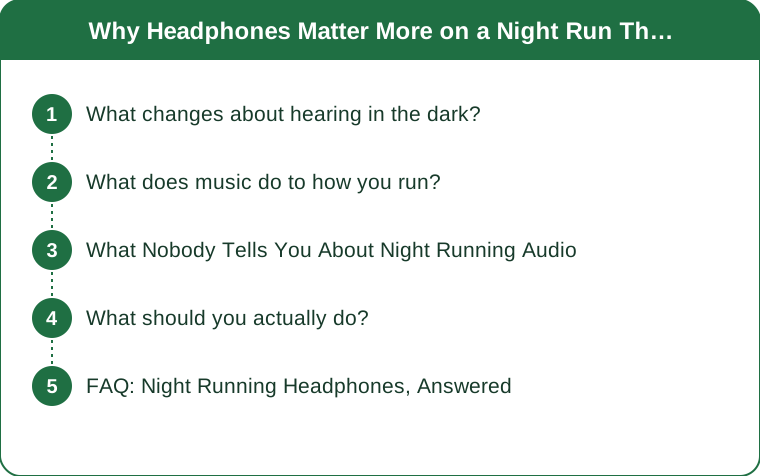
What changes about hearing in the dark?
Vision normally dominates spatial awareness, and in darkness it is heavily degraded. Peripheral vision in particular relies on light levels that street lighting does not provide.
Hearing takes over the early-warning role. Approaching cyclists, cars pulling out, other runners and dogs are all detected by ear before they are seen at night.
Directional hearing needs both ears. Working out where a sound came from depends on tiny differences in timing and volume between the two ears, so running with one earbud in halves that capability rather than reducing it slightly.
Wind and rain add masking noise, and autumn evenings bring both. The same volume that was fine in July can mask more in October.
Road surfaces sound different when wet, which changes the cues you have unconsciously learned to rely on for approaching traffic.
And reaction time matters more. With less visual warning, the interval between detecting something and needing to act is shorter, which makes the detection itself more valuable.
What does music do to how you run?
Music with a strong beat tends to entrain cadence. Runners commonly drift toward the tempo of what they are listening to, often without noticing.
That is useful in daylight on known ground and less useful in the dark, where the appropriate cadence is the one that matches what you can see.
Night running usually calls for a shorter, quicker, more controlled stride, keeping the foot closer underneath you on ground you cannot fully assess. A slow, long-strided track works against that.
Music also reduces perceived effort, which is a well-documented effect and generally a benefit. At night it can mean running faster than your visibility justifies.
It reduces attention to the surface too. Wet leaves, kerbs and uneven paving need more visual attention in the dark, and attention is finite.
None of this means running without music. It means choosing tempo deliberately, and considering podcasts or lower-tempo tracks for dark routes rather than the playlist that works at noon.
What Nobody Tells You About Night Running Audio
Bone conduction and open-ear designs exist for exactly this. They sit outside or in front of the ear canal and leave ambient hearing largely intact, which is why they have become the default among people who run in the dark.
Transparency modes are not equivalent. They pass a processed version of ambient sound through, which is better than nothing and is not the same as an open ear, particularly for locating direction.
One earbud in destroys directional hearing. It feels like a reasonable compromise and it removes the binaural comparison your brain uses to locate sound.
Volume matters more than the design. Any headphone at high volume masks the environment. Lowering the volume is the free version of this whole article.
Check local rules. Some organised races prohibit headphones, and in some places their use while running on roads is restricted. Worth knowing before an event.
Wind noise is worse with open designs, which is the genuine trade-off. In strong autumn wind, open-ear headphones can become both less useful for music and no better for awareness.
And your route choice interacts with all of it. A lit path away from traffic tolerates more audio isolation than a road route. Matching the audio to the route is more sensible than one rule for every run.
What should you actually do?
Use open-ear or bone conduction for dark routes. This is the single change that resolves most of the problem, and the sound quality trade-off is smaller than it used to be.
Keep the volume low enough to hear footsteps behind you. That is a practical, testable standard you can check on any run.
Never wear two occluding earbuds near traffic in the dark. If that is the only pair you own, take one out and accept the loss of direction sense, or run without.
Choose lower-tempo audio for technical or unlit ground, and save the fast playlist for lit, familiar, straightforward routes.
Be visible as well as aware. Reflective material at the ankles and wrists moves, and moving reflectors are recognised as human far sooner than static ones on a torso.
Look further ahead than feels necessary. With reduced visual information, early detection is worth more than good reactions.
Tell someone the route, or use a live-tracking feature, particularly as routes get darker through the autumn.
And re-evaluate familiar routes as the season changes. A route that was fine at seven in July is a different route at seven in October: darker, wetter, with different traffic and different surfaces. The route did not change; the conditions did, and the audio setup should change with them.
FAQ: Night Running Headphones, Answered
Are bone conduction headphones actually safer?
They leave the ear canal open, so ambient hearing is largely preserved. That is the safety argument, and volume still matters.
Is one earbud a reasonable compromise?
It preserves some hearing and eliminates your ability to locate sound direction, which is a significant loss in the dark.
Does music actually change my pace?
Yes, cadence commonly drifts toward the tempo of the music, and music also lowers perceived effort.
Are headphones allowed in races?
Rules vary by event and some prohibit them. Check the specific race rules beforehand.
What about transparency mode?
It is better than sealed listening and not equivalent to an open ear, particularly for judging direction.
What is the single most useful change?
Lower the volume until you can hear footsteps behind you. It costs nothing and addresses most of the risk.
TL;DR:
- Darkness degrades vision, so hearing carries more of your situational awareness at night.
- Occluding headphones remove the sense you are most dependent on, when you most need it.
- One earbud in eliminates directional hearing rather than halving it.
- Music entrains cadence and lowers perceived effort, which suits daylight better than dark ground.
- Use open-ear or bone conduction designs, and keep volume low enough to hear footsteps.
- Re-evaluate familiar routes in autumn; the route is the same and the conditions are not.
At night, the headphones are not a comfort decision. They are an input decision.
Keep Reading
This article is for general informational and styling purposes only. Fit, sizing, and product availability may vary.