Why Your Legs Feel Heavier on Night Runs Than the Exact Same Route in Daylight
Quick Answer: Legs often feel heavier on night runs due to a combination of accumulated daily fatigue (the body has been active for hours longer than on a morning run) and reduced visual feedback, which makes pacing and effort perception less precise. Neither indicates worse fitness — it’s a timing and sensory difference.
If your evening run on a familiar route consistently feels harder than the same distance in the morning, the explanation is mostly about when the run happens, not what’s wrong with your legs.

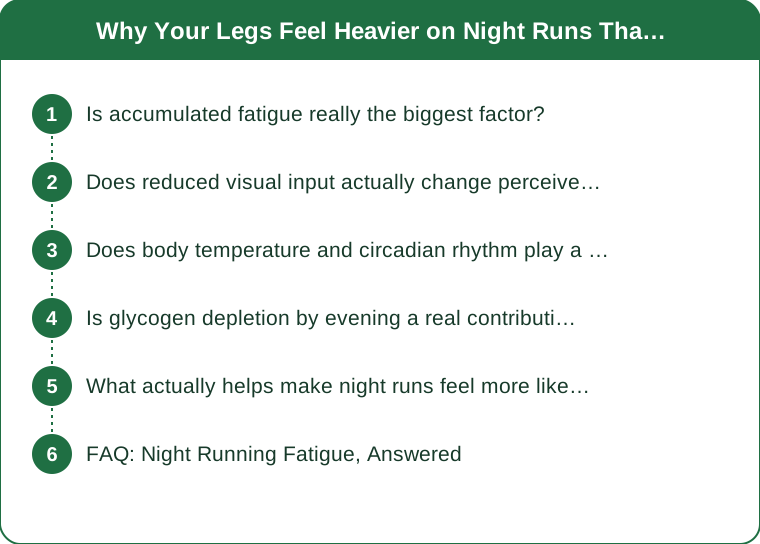
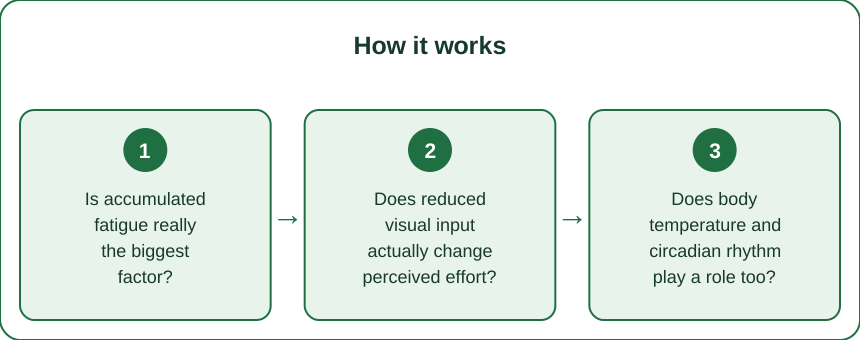
Is accumulated fatigue really the biggest factor?
Usually, yes — by evening, the body has already spent a full day’s worth of muscular micro-fatigue, glycogen use, and general tiredness before the run even starts, compared to a morning run starting from a rested state. This baseline fatigue difference alone can meaningfully change how a given pace feels, independent of actual fitness.
Does reduced visual input actually change perceived effort?
Yes, in a measurable way — limited visual feedback at night (harder to judge distance, terrain changes, and pacing landmarks) increases reliance on proprioception and effort sense, which for most runners feels less precise and more effortful than visually-anchored daytime pacing, even at an objectively identical pace.
Does body temperature and circadian rhythm play a role too?
It can — core body temperature naturally peaks in late afternoon to early evening for most people, which is often cited as a performance advantage for evening exercise, so the ‘heavier legs’ feeling isn’t a temperature issue for most runners. The fatigue and visual factors above are the more consistently cited explanations.

Is glycogen depletion by evening a real contributing factor?
For many runners, yes — if meals and snacks earlier in the day were lighter or spaced further apart from the run, glycogen stores available for an evening run may be somewhat lower than after a full night’s rest and a pre-run breakfast, contributing to the heavier-leg sensation independent of visual or fatigue factors.
What actually helps make night runs feel more like morning ones?
A small carbohydrate-containing snack 30-60 minutes before an evening run, plus running a well-lit, familiar route to reduce the visual-feedback gap, are the two most commonly cited fixes — addressing the fueling and sensory factors directly rather than assuming the fatigue is unfixable.
FAQ: Night Running Fatigue, Answered
Does GPS pace data actually match how a night run feels?
Often pace is objectively similar to a daytime run at the same effort, which is part of why the subjective ‘heavier legs’ feeling can be misleading about actual performance.
Should you compare night run times directly to morning run times?
It’s generally more useful to track effort and how you feel separately from morning runs, since the two aren’t run under equivalent baseline conditions.
Does hydration status by evening matter for this too?
Yes — cumulative mild dehydration by end of day is common and can compound the heavier-leg sensation, making consistent daytime hydration a relevant factor for evening run quality.
TL;DR:
- Night runs often feel harder due to accumulated daily fatigue, not lower fitness
- Reduced visual feedback makes effort perception less precise after dark
- Lower glycogen availability by evening can add to the heavy-leg sensation
- A pre-run snack and a well-lit familiar route address the two biggest fixable factors
The heaviness is real, but it’s about timing and sensory input — not a sign your training is going backward.
Keep Reading
This article is for general informational and styling purposes only. Fit, sizing, and product availability may vary.