Why Your GPS Watch Shows a Slower Pace at Night (Even When It Doesn't Feel Slower)
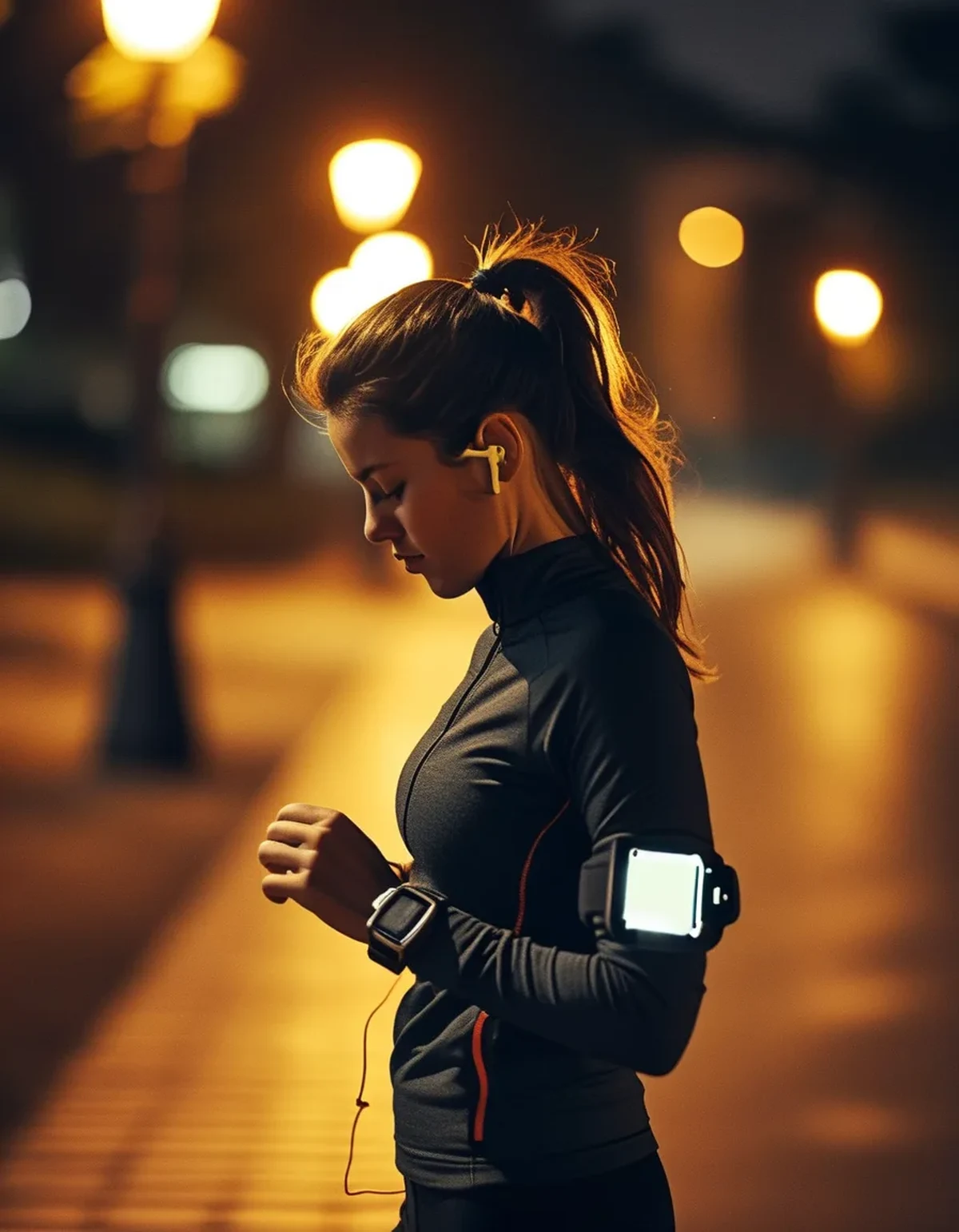
Quick Answer: GPS signal accuracy genuinely degrades slightly at night in many environments due to fewer visual reference points and, in some cases, different satellite geometry timing — but the bigger factor is usually that runners unconsciously slow down slightly in low light for safety, even when effort feels consistent.
Same route, same effort, slower number on the watch. Before blaming the GPS entirely, it’s worth knowing both things are probably true at once.

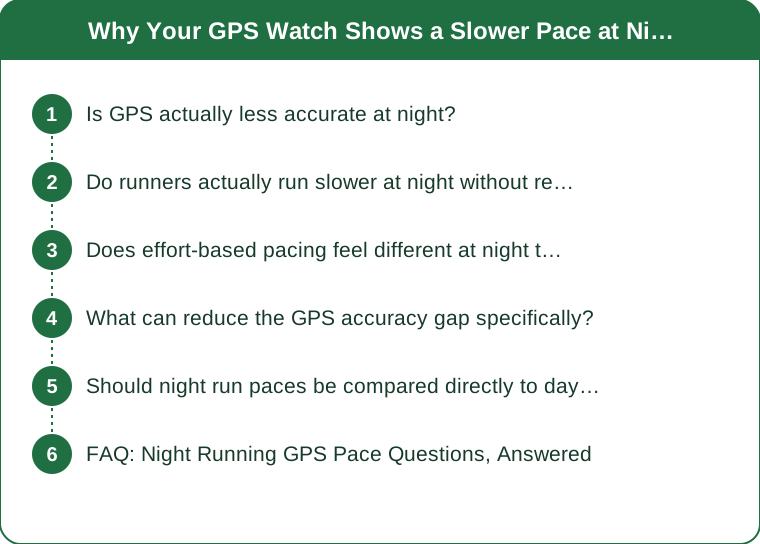
Is GPS actually less accurate at night?
To a small degree, yes — GPS accuracy isn’t directly tied to daylight, but environments common at night (tree cover, tall buildings, fewer clear sightlines) can compound with normal GPS drift, and route choices at night sometimes differ from daytime routes in ways that affect signal quality.
Do runners actually run slower at night without realizing it?
Very often, yes — reduced visibility naturally shortens stride length and reaction time for obstacles, curbs, and uneven surfaces, causing a real, if slight, pace reduction that doesn’t always register consciously as ‘running slower.‘
Does effort-based pacing feel different at night than pace-based pacing?
Yes — perceived effort at a given pace can feel harder at night due to increased mental load from navigating in low light, which is part of why the discrepancy between ‘felt effort’ and ‘GPS pace’ is more noticeable after dark.
What can reduce the GPS accuracy gap specifically?
Running routes with clearer sky visibility when possible, keeping the watch’s GPS settings on a higher-accuracy mode if available (even at the cost of battery life), and allowing a few minutes for satellite lock before starting the run.
Should night run paces be compared directly to daytime paces?
Not directly — it’s more useful to track night runs against other night runs on similar routes, since the combination of reduced visibility and any GPS variance makes a direct daytime comparison somewhat misleading for performance tracking.
FAQ: Night Running GPS Pace Questions, Answered
Does running with a headlamp change GPS accuracy?
No — a headlamp affects visibility and safety, not GPS satellite signal, so it won’t change the pace reading itself.
Is heart rate a more reliable night-running metric than pace?
For many runners, yes — heart rate reflects actual physiological effort regardless of slight visibility-driven pace changes, making it a more consistent night-to-night comparison.
Should I trust my watch’s night pace for race-pace training?
Use night runs for effort and heart-rate-based training rather than precise pace-per-mile calibration, and save exact pace-based workouts for daylight when possible.
TL;DR:
- Night running pace can read slower due to both minor GPS variance and real, often unconscious, stride shortening
- Reduced visibility naturally slows reaction time and stride, even when effort feels the same
- Compare night runs to other night runs, not directly to daytime paces
- Heart rate is often a more reliable night-training metric than exact GPS pace
If your night pace looks off, trust your heart rate and perceived effort over the exact number on the watch.
Keep Reading
This article is for general informational and styling purposes only. Fit, sizing, and product availability may vary.