Why Do You Trip More on a Familiar Path at Night?
Quick Answer: In daylight your eyes take frequent quick samples of the ground two to four steps ahead and your feet adjust automatically. At night the useful visual range collapses, and on a familiar route your brain substitutes memory for those samples — so you are running on a mental map that does not include tonight’s fallen branch.
The path you have run four hundred times is the one you fall on.
That is not bad luck. It is exactly what you would predict.
This is general information, not medical advice.

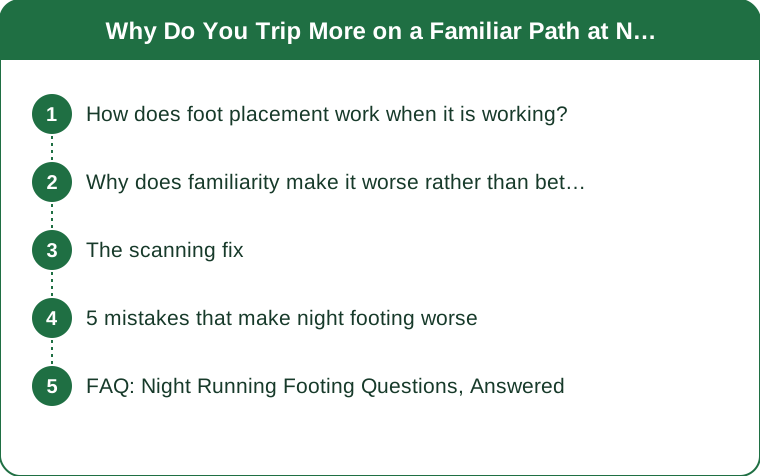
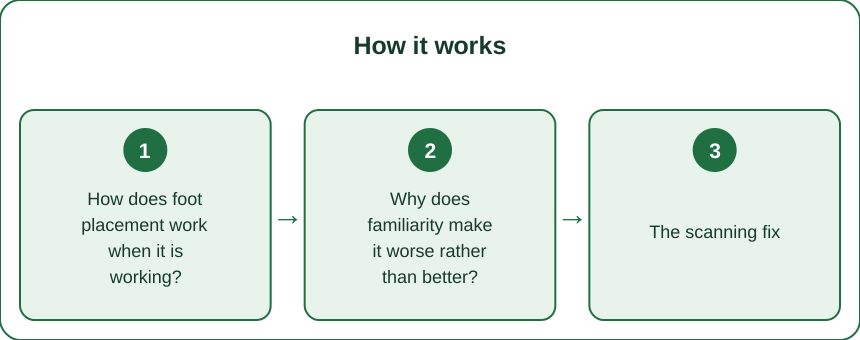
How does foot placement work when it is working?
Mostly through brief, well-timed glances rather than continuous watching.
When you run over uneven ground, your visual system samples the terrain a short distance ahead — typically about two steps in front of you — and that information is used to plan where the foot lands. You are not consciously watching your feet. The sampling happens fast, it happens repeatedly, and the adjustments arrive before you notice needing them.
The key detail is that this system is predictive. It gathers information about ground you have not reached yet and uses it to set up the landing in advance. There is not enough time to react once your foot is already descending.
At night, two things degrade at once. The information available per sample drops — less light means less contrast, and contrast is what reveals a raised edge or a hole. And the effective preview distance shrinks, particularly with a headlamp, which lights a pool a few metres ahead and leaves everything beyond it dark.
So you are planning fewer steps ahead with worse information, at the same running speed.
Is that why it feels more tiring?
Partly. More attention spent on foot placement is genuine cognitive load, and the shorter stride most people adopt at night is less economical.
Why does familiarity make it worse rather than better?
Because a good internal map is a reason to stop looking.
On a known route your brain has a detailed model of the terrain, and that model is usually accurate enough to run on. Under low light, where visual sampling is expensive and unrewarding, leaning on the model is efficient — and largely unconscious.
The failure mode is obvious once stated: the model is from last time. It does not contain the branch that came down in the wind, the new pothole, the bin left out, or the section of path that has lifted since the roots grew.
This is why the trip usually happens on the familiar stretch rather than the unfamiliar one. On unknown ground you are already sampling carefully. On known ground you are running on memory.
Seasonally this gets worse right about now. Late summer into autumn is when paths change fastest — leaf fall, dropped fruit and nuts, wet patches that were dry all summer, and the first branches down in a storm. Your map is degrading weekly while your confidence in it is unchanged.
Does that mean I should run unfamiliar routes at night?
No — familiar routes are still safer overall for navigation and personal safety. The fix is not changing the route, it is changing how you look at it.

The scanning fix
The goal is to restore the preview, which means changing what your light does and where your eyes go.
1. Aim the headlamp further out than feels natural. Most people angle it down at their feet, which lights ground they have already committed to. Angling it to land 6 to 10 metres ahead gives you preview distance instead of confirmation. It feels wrong for the first kilometre because the immediate ground goes darker; that ground was not the useful part.
2. Add a second light source at waist or hand height. A headlamp at eye level casts almost no shadows, and shadows are how you see height. A light held low — a handheld or a waist lamp — creates side-shadow that makes raised edges visible. This is the single biggest improvement for surface detection and almost nobody does it.
3. Deliberately scan, in a pattern. Instead of staring at one spot, sweep your gaze from the far edge of your lit area back toward mid-distance every few strides. The point is to keep sampling rather than settling.
4. Shorten stride slightly on the known stretches. Not everywhere — specifically the places you would otherwise stop looking. A shorter stride reduces the consequences of a bad landing and increases how often you can adjust.
5. Re-scout after weather. After a windy day or heavy rain, treat your familiar route as unfamiliar for one run. That single mental reframe restores the sampling behaviour.
5 mistakes that make night footing worse
1. A brighter headlamp instead of a better-placed one. More lumens aimed at your shoelaces does not help. Beam angle and a low secondary light matter far more than raw output.
2. Running the same route in the same direction every time. The map gets stronger and the sampling gets weaker. Reversing the direction weekly keeps the terrain slightly novel and the attention slightly higher.
3. Headphones at a volume that removes footfall sound. You get real surface information from how your feet sound — wet, loose, gritty. Losing that removes a channel you did not know you were using.
4. Assuming the streetlit sections are the safe ones. Streetlights create high-contrast pools and deep shadows, and your eyes take time to adapt between them. Some of the worst footing is at the boundary where you have just left a bright pool and your dark adaptation has not caught up.
5. Running the same pace as daylight. A modest reduction is appropriate and most people already do it unconsciously. Fighting to hold your daytime pace in the dark removes the adjustment margin you need.
FAQ: Night Running Footing Questions, Answered
How long does it take your eyes to adapt to darkness?
Substantial adaptation happens in the first several minutes, and it continues improving for considerably longer. The practical implication is that repeatedly passing through bright light resets part of it — which is why a route with intermittent streetlights can feel harder to see on than a consistently dark one.
Are trail shoes better for night running on paths?
On genuinely mixed surfaces, yes — more grip and usually more underfoot protection when you do clip something. On pavement they are unnecessary. The bigger factor is that a shoe you are confident in reduces the tentative running that itself causes trips.
Does the clock change matter?
A lot, and mostly because your usual run suddenly happens in the dark without you having planned for it. The first two weeks after the change are worth treating as a new routine rather than the same one.
Should I use reflective gear even on a car-free path?
Yes for cyclists and other runners, who close distance fast and see you late. Ankle reflectors are particularly effective because the motion of running makes them unmistakably human.
What should I do if I do trip and catch myself?
Stop and check rather than running it off — ankle and knee complaints from a near-fall often surface a few minutes later. If anything hurts on weight-bearing, walk it in and get it looked at if it persists.
TL;DR:
- Foot placement runs on brief predictive glances about two steps ahead; darkness shrinks both the information and the preview.
- On familiar routes your brain substitutes last week’s map, which does not include tonight’s obstacles.
- Aim the headlamp 6 to 10 metres out, and add a low light for shadows that reveal height.
- Scan actively, shorten stride on the stretches you would otherwise stop watching, and re-scout after weather.
- Autumn changes paths faster than any other season, exactly when night runs start earlier.
The route you know best is the one you look at least. Making yourself look at it again is the whole fix.
This is general information, not medical advice.
Keep Reading
This article is for general informational and styling purposes only. Fit, sizing, and product availability may vary.