Why Night Runs Feel Harder Even at the Same Pace
Quick Answer: Night runs feel harder because reduced visual information increases cognitive load, your body temperature and circadian rhythm are past their peak, accumulated daily fatigue is present, and depth perception in low light makes footing require constant attention. The pace is genuinely the same; the perceived effort is genuinely higher, and both facts can be true.
You check your watch expecting a bad number. The number is fine. It is the same pace you ran on Saturday morning, when it felt easy.
But this run has felt like work from the first half mile.
Several things are actually different, and none of them are about fitness or willpower.

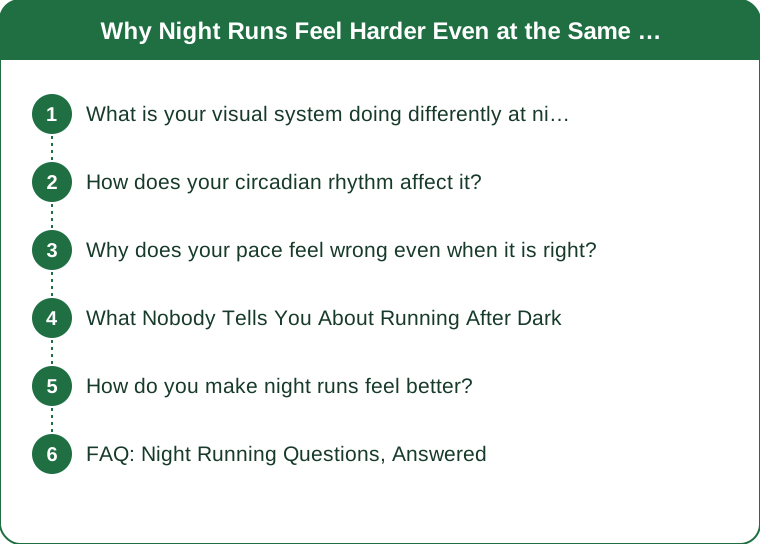
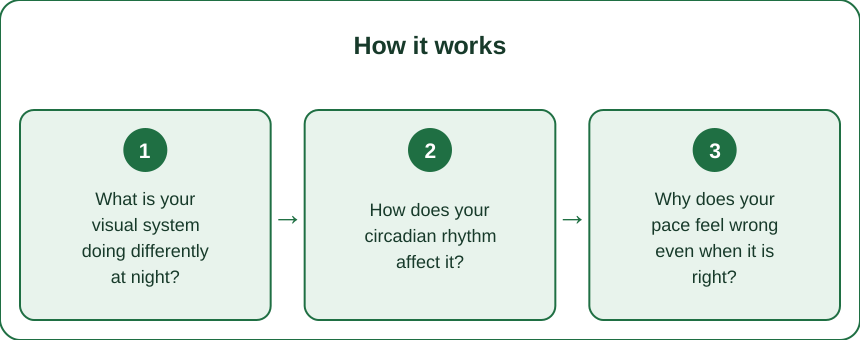
What is your visual system doing differently at night?
Working much harder, and it costs you.
Vision is your primary source of information while running, and low light degrades it substantially. Your brain compensates by increasing attention to what visual information remains, which is genuine cognitive work.
Specifically:
- Depth perception drops sharply in low light. Judging distance to a curb, a root, or an uneven patch requires more processing and more caution.
- Peripheral vision degrades faster than central vision in dim conditions, so you scan more actively to compensate.
- Contrast sensitivity falls, which is why an uneven surface that was obvious at noon is invisible at 9pm.
The consequence is measurable: elevated cognitive load raises perceived exertion at identical physical output. This is well documented in exercise research, and it explains a substantial share of the effect.
There is a muscular component too. Uncertain footing makes you land more cautiously and stabilize more actively — slightly shorter stride, more work through the ankles and hips. That is real additional work that never shows up in your pace.
How does your circadian rhythm affect it?
It depends heavily on the hour, and the picture is more nuanced than most people assume.
Core body temperature peaks in the late afternoon and early evening, and that peak is generally favorable for performance — better muscle compliance, better enzyme activity, better reaction time. Many people actually perform best around 5 to 7pm.
But by 9 or 10pm, temperature is falling and melatonin production has begun. The physiological state is shifting toward sleep, and running against that shift feels harder.
The other factor is simple accumulation. A run at 9pm follows a full day of standing, walking, working, and decision-making. Morning runs start from a rested baseline; night runs do not. Sleep debt, if present, compounds it further.
Practical implication: an early evening run and a late evening run are different events. If your night runs consistently feel terrible, moving them 90 minutes earlier often resolves it entirely, without changing anything else.
Why does your pace feel wrong even when it is right?
Because you estimate pace largely from visual flow, and there is much less of it at night.
Optic flow — the rate at which the environment streams past your peripheral vision — is a primary cue for perceived speed. In darkness there are far fewer visual references passing by, so the flow signal weakens and you feel slower than you are.
This produces a specific and common pattern: runners unconsciously speed up at night to make the effort match their expected sensation, then wonder why the run felt hard. The watch was right; the feeling was calibrated to daylight.
Two other perceptual factors:
- Time perception distorts in low stimulation. Fewer landmarks means fewer subjective progress markers, and a familiar route can feel considerably longer.
- Sound becomes more prominent, which increases arousal and vigilance. That heightened alertness has a real energetic cost.
The practical fix: run by effort or heart rate at night rather than by feel, and check your watch more often than you would in daylight. Most people who do this discover they have been running their night miles faster than intended, which explains a good portion of the difficulty.

What Nobody Tells You About Running After Dark
Cooler night air is a genuine performance advantage that gets masked by everything else. Late summer evenings are often 15 degrees cooler than the afternoon, which meaningfully reduces cardiovascular strain. The run may feel harder while being physiologically easier — a strange but common combination.
Your form changes without your noticing. Low light produces a shorter, more cautious stride with more ground contact time. Over a long run this is a real efficiency cost, and it is why night runs sometimes leave you more sore at the same distance.
Headlamps change proprioception in an odd way. They light what you are looking at and leave everything else dark, which narrows your effective visual field. A headlamp with a wider beam, or one worn at waist level, casts side shadows that actually improve depth perception on uneven ground.
Vigilance has a metabolic cost. If you are running somewhere that requires alertness for safety, the sustained arousal genuinely adds to fatigue. This is not imagined and it does not indicate poor fitness.
Post-run sleep can suffer. Vigorous exercise within roughly two hours of bed elevates core temperature and heart rate enough to delay sleep onset for some people. If your night runs are affecting your sleep, moving them earlier helps more than any wind-down routine.
Familiar routes feel different in the dark in a way that is disproportionate to the actual change. The landmarks that segment a route mentally disappear, and a route you know perfectly becomes a longer, vaguer thing.
How do you make night runs feel better?
Several adjustments, in rough order of effect:
Move it earlier if you can. A 6:30pm run and a 9:30pm run are not the same. This is the largest single lever.
Improve your light. A brighter, wider headlamp or a waist lamp reduces cognitive load substantially. Waist-level lighting casts shadows that reveal surface texture, which upper-head lighting flattens out.
Run a well-lit, familiar route. Novelty adds cognitive load, and at night that cost is amplified. Save new routes for daylight.
Pace by heart rate or effort, and check often. This alone resolves the speeding-up problem that causes many bad night runs.
Eat something small 60 to 90 minutes before. Evening runs often follow a long gap since lunch, and low energy availability feels exactly like poor fitness.
Extend your warm-up. Muscles are not warmer just because the day was. In cooler evening air a longer, more gradual warm-up matters.
Be visible. Reflective gear and a light are safety equipment, not accessories, and the reduced anxiety of being clearly visible has its own effect on how the run feels.
Adjust expectations rather than pace. Accept that night runs at the same pace feel harder and that this is normal. That reframe alone changes the experience, because much of the difficulty comes from interpreting the sensation as a bad sign.
This is general information, not medical advice.
FAQ: Night Running Questions, Answered
Is it worse to train at night than in the morning?
No. Late afternoon and early evening are physiologically favorable windows. Consistency matters far more than time of day, and the best time to run is the one you will actually do regularly.
Will running at night hurt my sleep?
For some people, vigorous exercise within two hours of bedtime delays sleep onset. Many people are unaffected. If you are, finishing 90 minutes or more before bed and taking a cool shower afterward usually resolves it.
Should I run slower at night?
Run by effort rather than by target pace. Your pace at a given effort may be a little slower, which is normal, and forcing the daytime number is how a hard-feeling run becomes an actually hard run.
TL;DR:
- Low light raises cognitive load, and cognitive load raises perceived effort at identical output.
- Weakened optic flow makes you feel slower, so most runners unconsciously speed up.
- Late evening runs fight your circadian shift toward sleep; early evening is a performance peak.
- Better and wider lighting — especially at waist level — reduces the effort meaningfully.
- Pace by heart rate, extend the warm-up, and move the run earlier if the schedule allows.
The most useful adjustment is the mental one: a night run that feels harder at the same pace is behaving exactly as expected. It is not a fitness signal, and treating it as one is what turns a normal run into a discouraging one.
Keep Reading
This article is for general informational and styling purposes only. Fit, sizing, and product availability may vary.