Why Night Run Recovery Takes Longer Than the Same Morning Run
Quick Answer: The run is the same; the recovery window is not. A late run raises core temperature and adrenaline at the exact hours your body needs both falling in order to enter deep sleep - and deep sleep is when most physical repair happens. Add later, larger post-run meals and a compressed gap before bed, and you lose an hour or two of your best recovery sleep without noticing you lost it. The fixes are mostly about the ninety minutes after you stop, not the run itself.
Which is worth knowing before you decide that evening running does not suit you.

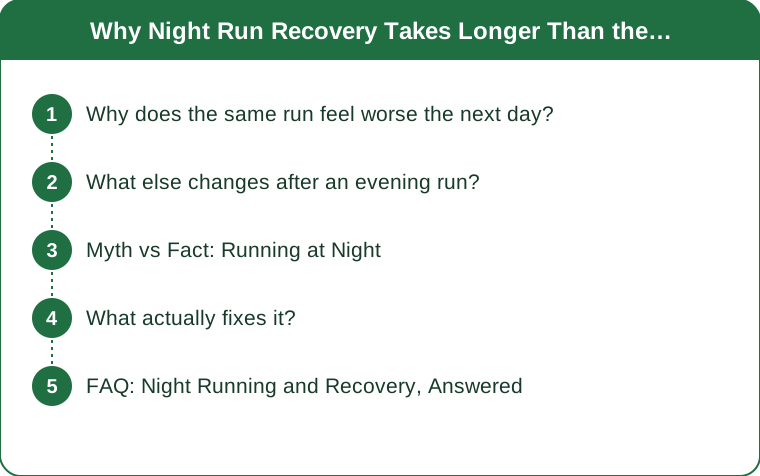
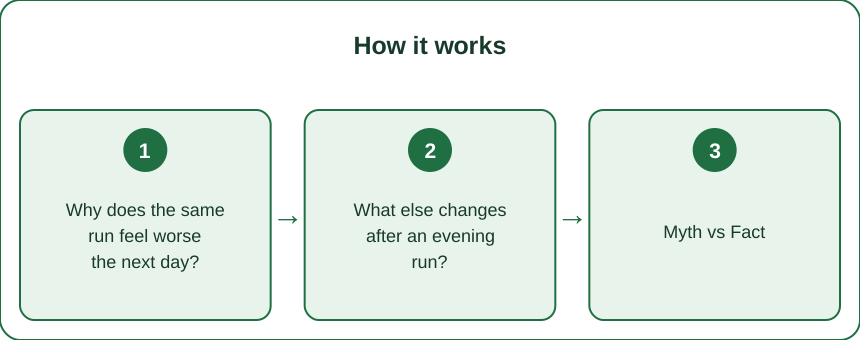
Why does the same run feel worse the next day?
Because recovery is scheduled, and a late run collides with the schedule.
Core temperature has to fall for sleep to begin properly. Your body drops roughly a degree in the evening as a sleep signal, and running reverses that - a hard evening run can leave core temperature elevated for over an hour after you stop. Sleep onset waits for the drop, so a 9pm finish often means a genuinely later sleep start even when you are in bed on time.
Deep sleep is front-loaded. The largest share of slow-wave sleep - the stage most associated with physical repair - happens in the first few cycles of the night. Losing an hour at the start costs disproportionately more repair than losing an hour at the end, which is why a late night followed by a lie-in does not feel equivalent.
Adrenaline and cortisol lag behind the effort. Both stay elevated after hard exercise, and both actively oppose sleep onset. The harder the finish, the longer the tail - a sprint finish is much more disruptive than an easy jog home.
And the muscle damage is identical. Nothing about the run itself is harder at night. The difference is entirely in what happens after it, which is genuinely good news, because that part is adjustable.
What else changes after an evening run?
Several small things, all pointing the same direction.
Fuelling gets worse. Post-run at 9:45pm is not when most people eat a considered recovery meal. It is when they eat toast, or nothing. Protein intake in the hours after a run supports repair, and evening runners routinely under-eat protein and then sleep for eight hours without any.
Or they overeat, late. The other failure mode - a large meal close to bed - degrades sleep quality in its own right, particularly if it is high fat. Neither extreme helps.
Hydration goes unfixed. Morning runners rehydrate across a whole day. Evening runners have about an hour before they deliberately stop drinking so they are not up at 3am, which means a fluid deficit carried through the night.
The stretch and cool-down gets skipped more often, because there is a bedtime pulling at it. A morning run has a day to loosen up in; an evening run goes almost straight to eight hours of stillness.
And you are already fatigued when you start. By 9pm you have accumulated a day of standing, working, and decision-making. The same pace draws on a smaller reserve, which raises the true cost of the session even when the numbers look identical.

Myth vs Fact: Running at Night
Myth: evening exercise ruins sleep for everyone. Fact: the research is more forgiving than the folklore. Moderate evening exercise finishing 90 minutes or more before bed is fine for most people and may improve sleep. The problem is specifically vigorous exercise finishing close to bedtime.
Myth: you should run in the morning instead. Fact: the run you actually do beats the theoretically better one you skip. Evening is when many people can genuinely train, and the recovery cost is manageable with adjustments.
Myth: a hot shower helps you wind down. Fact: a warm shower helps, and the mechanism is counterintuitive - it pulls blood to the skin so core temperature drops faster afterward. A very hot shower right before bed works against you.
Myth: feeling tired means you will sleep well. Fact: physical tiredness and sleep readiness are different systems. You can be exhausted and wired simultaneously, which is precisely what a hard late run produces.
Myth: your watch would tell you. Fact: consumer sleep staging is approximate, and recovery scores often read fine after a poor night. Morning resting heart rate and how the first ten minutes of your next run feel are more honest signals.
What actually fixes it?
Six adjustments, roughly in order of impact.
1. Finish 90 minutes before bed. This is the single largest lever. Moving a 9:30pm finish to 8:45pm changes more than any supplement or stretch routine, because it gives core temperature and adrenaline time to fall on their own.
2. Cool down properly. Five to ten minutes of easy jogging or walking, then a warm - not hot - shower. The shower accelerates the temperature drop, which is exactly what you want.
3. Eat protein within the hour, even if small. 20 to 30g is a reasonable target. Greek yoghurt, milk, or a shake are easier than a meal at that hour and considerably better than nothing.
4. Keep the finish easy. Save intervals and sprint finishes for daytime sessions where possible. A hard finish extends the adrenaline tail by the most, and it is the most avoidable part.
5. Sort the bedroom temperature. Cool room, thin bedding. You are trying to help a process the run interfered with, and ambient temperature is the cheapest available help.
6. Hydrate on a schedule, not at the end. Drink through the run and immediately after, then taper. Front-loading avoids the choice between dehydration and a 3am wake-up.
As late summer turns, one seasonal note: cooler September evenings actually make this easier, because a lower ambient temperature helps core temperature fall faster after you stop. The same 9pm run is genuinely less disruptive in October than in August.
This is general information, not medical advice. Persistent sleep problems are worth raising with a professional rather than training around.
FAQ: Night Running and Recovery, Answered
How long before bed should I finish a run?
Ninety minutes is a good default for a moderate run, and two hours for anything hard. Below an hour, most people notice a real cost in sleep onset.
Is a hot bath after a night run a good idea?
Warm rather than hot, and ideally at least an hour before bed. A warm bath can help by triggering a rebound temperature drop; a very hot one close to bed keeps core temperature high when it needs to fall.
Should I eat after a late run or just sleep?
Eat something with protein. A very late large meal is not ideal, but going to bed with nothing after a hard run leaves repair under-resourced. A small protein-focused snack is the compromise.
Why do my legs feel heavy the next morning even after enough hours of sleep?
Hours in bed and recovery sleep are not the same. A late run pushes back sleep onset and compresses early-night deep sleep, which is where most physical repair happens.
Does this mean evening running is worse for fitness?
Not inherently. Some measures of performance actually peak in the late afternoon and early evening. The issue is the recovery window afterward, and that is adjustable.
What if 9pm is the only time I can run?
Then run at 9pm. Keep the finish easy, cool down deliberately, take protein, and accept that hard sessions should be moved to weekends when the timing can be better.
TL;DR:
- The run is identical - the recovery window is what changes.
- A late run keeps core temperature and adrenaline elevated when both need to fall, delaying sleep onset and cutting into early-night deep sleep.
- Evening runners also under-fuel protein, under-hydrate, and skip the cool-down more often.
- Best fixes: finish 90 minutes before bed, cool down and shower warm, take 20-30g protein, keep the finish easy.
- Cooler autumn evenings genuinely reduce the cost - the same run disrupts less in October than in August.
Evening running is not the problem. The ninety minutes after it usually are, and that is the part you can redesign this week.
This is general information, not medical advice.
Keep Reading
This article is for general informational and styling purposes only. Fit, sizing, and product availability may vary.