Why Late Summer Humidity Makes Night Runs Feel Different Than Daytime Heat
Quick Answer: Night runs in late summer feel harder than the temperature suggests because humidity stays high after sunset even as air temperature drops, and humidity is what prevents sweat from evaporating. Above a dew point of about 65F, cooling becomes inefficient and heart rate rises 5 to 15 beats per minute at the same pace. Check the dew point rather than the temperature, slow your pace by 30 to 60 seconds per mile, and treat these runs as easy efforts regardless of what the plan says.
This is the most misread condition in summer running. Daytime heat is obvious and people adjust for it. A warm humid night looks benign on a weather app and is often the more taxing run of the two.

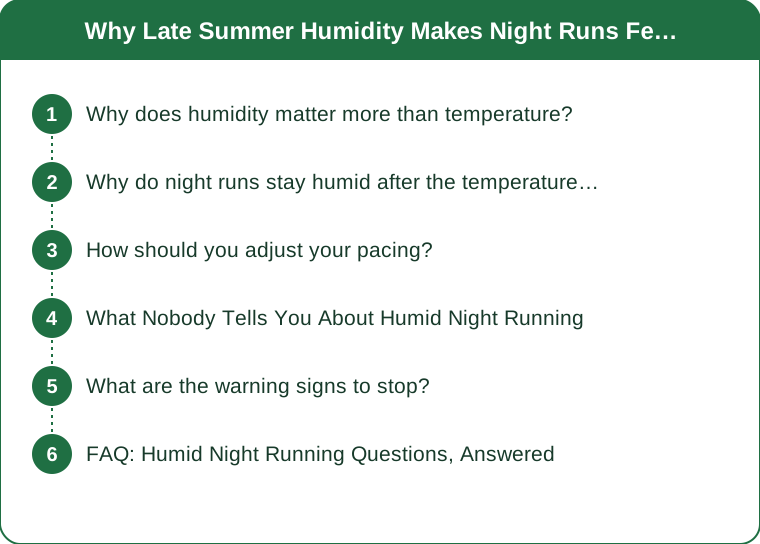
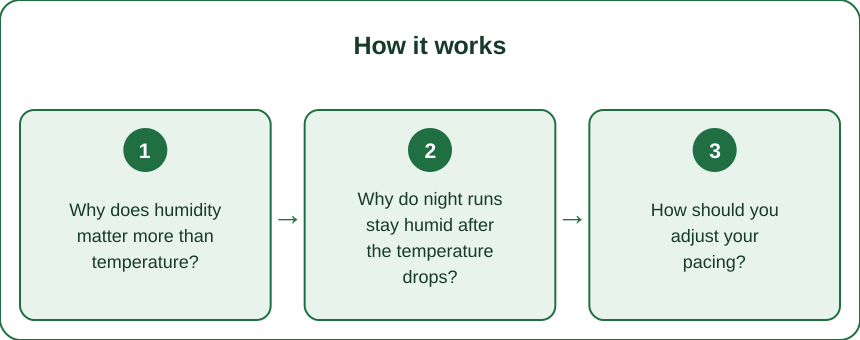
Why does humidity matter more than temperature?
Because your entire cooling system depends on evaporation.
Sweating does not cool you. Sweat evaporating cools you. The change of state from liquid to vapour draws heat from your skin, and that is close to your only meaningful cooling mechanism during exercise.
When the air is already near saturation, evaporation slows dramatically. The sweat still arrives — more of it, in fact — but it drips instead of evaporating, so you lose fluid without getting the cooling benefit. That is the worst possible combination.
Core temperature then climbs, and your body responds by sending more blood to the skin to shed heat. That blood is no longer available to working muscle, so your heart compensates by beating faster. This is why heart rate at a given pace rises 5 to 15 beats per minute in humid conditions, and it is a genuine physiological cost rather than a perception issue.
Dew point is the number that captures this. Below 55F is comfortable, 60 to 65F is noticeable, 65 to 70F is difficult, and above 70F is genuinely limiting for most runners.
Why do night runs stay humid after the temperature drops?
Because falling temperature raises relative humidity rather than lowering it.
Dew point stays fairly stable through the evening — it reflects the actual moisture in the air. Air temperature drops after sunset. As the gap between them narrows, relative humidity climbs, often reaching 85 to 95 percent by late evening on a late-summer night.
So the run that looked comfortable at 72F is happening in near-saturated air. The air is cooler and your ability to cool yourself is worse, which is the counterintuitive part that catches people out.
Ground-level conditions add to it. Grass, parks, and areas near water release moisture into the air as they cool, so a park route can be measurably more humid than a road route on the same night.
Still air makes it worse again. Daytime often brings breeze; late evening frequently does not, and moving air is what carries humid air away from your skin so evaporation can continue.
How should you adjust your pacing?
By effort, not by the number on the watch.
A reasonable adjustment scale by dew point:
- 60 to 65F: add 15 to 30 seconds per mile
- 65 to 70F: add 30 to 60 seconds per mile
- 70 to 75F: add 60 to 90 seconds per mile, and consider shortening
- Above 75F: easy effort only, or move indoors
These are approximate and individual variation is wide. Run by heart rate or breathing rather than by pace on humid nights, and accept that the same effort produces a slower time.
Hard interval sessions are the ones to move. Trying to hit paces in high humidity means either failing the session or overreaching to hit numbers your body cannot support that night, and neither produces useful training. Shift the quality work to the coolest window of your week and let the humid nights be easy volume.
One useful marker: if you cannot hold a conversation at your usual easy pace, the conditions have changed the run whether you acknowledge it or not.

What Nobody Tells You About Humid Night Running
You acclimate, and it takes longer than people expect.
Heat and humidity adaptation takes roughly ten to fourteen days of consistent exposure, and it produces real physiological change: increased plasma volume, earlier sweating onset, and more dilute sweat that conserves electrolytes. Runners who train through a humid stretch genuinely handle it better by the end.
The catch is that adaptation fades within one to two weeks of cooler conditions. Late August is exactly when many people are best adapted and about to lose it — and the first cool dry night of September will feel spectacular partly for that reason.
Second thing: sweat rate in humid conditions can exceed two litres an hour, and thirst lags well behind actual loss. Weigh yourself before and after a humid run once — every pound lost is roughly 16 ounces of fluid to replace. Most people are surprised.
Third: clothing choice matters more here than in dry heat. A technical fabric that wicks well is close to useless when the air cannot accept more moisture, so the priority shifts to minimal coverage and maximum airflow rather than to wicking performance. Less fabric beats better fabric.
And fourth: chafing is dramatically worse in humidity because the skin stays wet for the entire run. Apply balm before you leave, not after you notice.
What are the warning signs to stop?
Heat illness in humid conditions develops faster than in dry heat, and the signs are worth knowing precisely.
Stop and cool down if you experience: a headache during the run, nausea, dizziness, confusion or difficulty concentrating, skin that has stopped sweating, or a heart rate that stays elevated after you slow down.
Goosebumps or chills in warm conditions are a particularly important sign and are frequently ignored. Feeling cold on a warm humid night means your thermoregulation is failing, not that the weather turned.
If someone becomes confused, stops sweating, or loses coordination, that is a medical emergency — cool them aggressively and call for help. Heat stroke progresses quickly and is not something to walk off.
Lower-risk practices for humid evenings: run loops near a water source rather than a point-to-point route, carry fluid for anything over 40 minutes, tell someone your route, and do not push a session because it is on the plan. The plan did not know about the dew point.
This is general information, not medical advice.
FAQ: Humid Night Running Questions, Answered
Is running at night better than morning in summer?
Usually not, despite the lower temperature. Dew point typically peaks in the pre-dawn and evening hours while air temperature is lowest around sunrise, so early morning generally offers the better combination for most locations.
Does an electrolyte drink help in humidity?
For runs over an hour with heavy sweating, yes. Sodium replacement matters when sweat losses are high, and plain water in very large volumes without sodium carries its own risk. Under an hour, water is fine for most people.
Why does my watch pace look terrible even though the effort felt hard?
Because it was hard — humidity raises cardiovascular cost at any given pace. The watch is measuring speed, not effort. Compare heart rate against your usual easy range and you will see the run was exactly as hard as it felt.
TL;DR:
- Humidity blocks sweat evaporation, which is your main cooling mechanism, so heart rate climbs 5 to 15 bpm at the same pace.
- Evening relative humidity rises as temperature falls, so warm humid nights are harder than the thermometer suggests.
- Check dew point, not temperature, and add 30 to 60 seconds per mile above 65F dew point.
- Chills, headache, nausea, or stopped sweating mean stop immediately — these develop faster in humidity.
Look up the dew point before tonight’s run instead of the temperature. It explains more about how the last month of running has felt than any other number available to you.
This is general information, not medical advice.
Keep Reading
This article is for general informational and styling purposes only. Fit, sizing, and product availability may vary.