Why Earlier Sunsets Change Your Night Run Before the Clocks Do
Quick Answer: Between mid-August and late September, sunset moves earlier by roughly 1 to 2 minutes per day in the northern mid-latitudes — about 45 minutes over six weeks. A run that started in usable light in early August starts in full dusk by mid-September, at the same clock time. The fix is to move your start time earlier by 15 minutes every two weeks rather than waiting for a single uncomfortable adjustment.
Nothing about your route changed. Your pace did not change. But the run feels different, and it has felt slightly more different every week for about a month.
You will probably blame the humidity, or your legs, or a bad week of sleep. The likeliest culprit is much simpler: you are now running in meaningfully less light than you were in early August, at exactly the same time on the clock.

How much does sunset actually move in late summer?
Faster than almost anyone estimates.
Around the equinoxes, the sun’s position changes most rapidly. In the northern mid-latitudes — roughly 40 degrees north, which covers most of the US Northeast and Midwest — sunset shifts earlier by about 1 to 2 minutes per day through late August and September.
Over a six-week stretch that is around 45 minutes. A 7:30pm start that began in usable light in the first week of August is running into genuine dusk by the middle of September.
Civil twilight matters more than sunset itself. Sunset is the moment the sun’s edge touches the horizon; there is usable light for roughly another 25 to 30 minutes after that at this latitude. That twilight window is what most evening runners are actually using, and it is shrinking at the same rate.
The reason this goes unnoticed is that a one-minute change is invisible day to day. It only becomes obvious when something forces a comparison — the first run where you genuinely could not see the surface.
What actually gets harder as light drops?
Three specific things, in a fairly predictable order.
Surface reading goes first. Your ability to judge camber, cracks, and small height changes depends on shadows, and shadows fade before overall brightness does. This is why the first symptom is usually a shortened stride rather than anything you would consciously notice — your body reduces risk by keeping your feet closer to the ground.
Depth perception goes second. In low light your eyes shift toward rod-dominant vision, which is good at detecting movement and poor at judging distance. Kerbs, steps, and the exact position of an approaching cyclist all become harder to place.
Colour goes last and least usefully. Rods do not carry colour information, which is why everything looks blue-grey at dusk. A brown dog on a brown path becomes genuinely hard to separate.
The practical result is that your pace at a given effort drops by a few seconds per kilometre in low light without any change in fitness. If you are watching pace, you will read this as getting slower.
What Nobody Tells You About the Dusk Window
Dusk is harder to run in than full dark, and most people have this backwards.
In full darkness, your eyes are fully dark-adapted, your headlamp is doing consistent work, and drivers have their headlights on. The environment is uniform and your equipment matches it.
At dusk, none of that is true. There is enough ambient light that your eyes stay partly light-adapted and never fully adjust. Your headlamp is competing with residual daylight, so it does not produce the strong shadow contrast that makes surfaces readable. And crucially, many drivers have not yet turned their headlights on, which means the thing that normally makes cars visible to you is missing.
There is also a specific hazard in the western-facing part of any dusk route: for about twenty minutes after sunset, the western sky stays bright while the ground goes dark. Anyone looking west — including drivers — is looking into glare with a dark foreground. If your route includes a west-facing road crossing, that crossing is the least safe part of your run for a narrow window each evening.
Full dark is, genuinely, the easier condition. Dusk is the one that needs planning.
How should you adjust as the weeks go on?
Gradually, on a schedule, rather than all at once when it becomes a problem.
Move your start earlier by 15 minutes every two weeks from mid-August. This roughly tracks the sunset drift and means you never experience a sudden change. The alternative — holding your time until a run feels genuinely unsafe and then moving it by 45 minutes — is a much larger disruption to the rest of your evening.
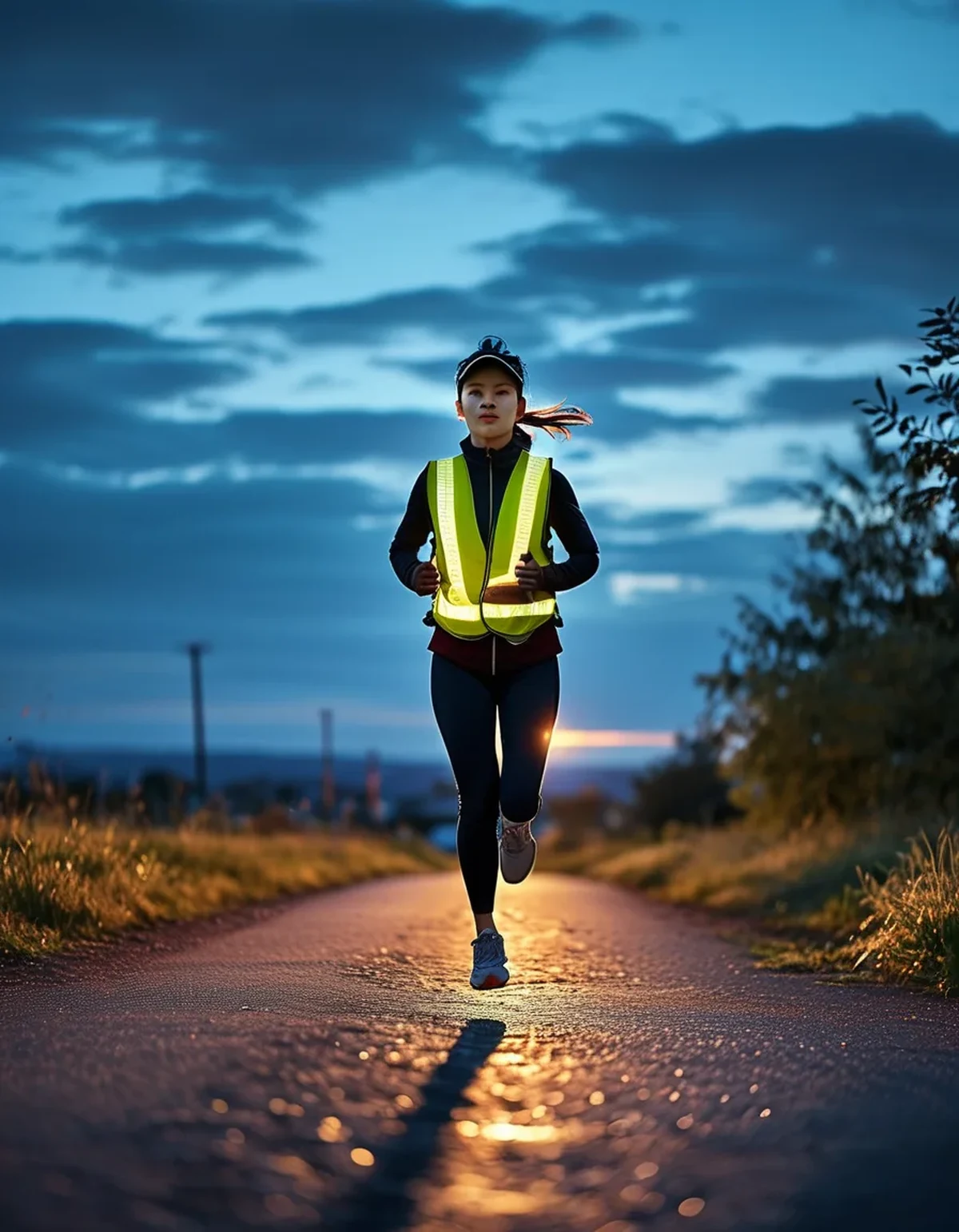
Bring the reflective gear out before you think you need it. The useful threshold is not when it is dark but when drivers might not have their lights on yet, which is earlier. A reflective vest at 7:15pm in early September looks excessive and is not.
Switch the headlamp on at dusk, not at dark. Its job in the dusk window is being seen, not seeing. Low power is fine and the battery lasts longer.
Reverse your route direction once a week. The specific value here in autumn is that the same route has a different west-facing exposure in each direction, so alternating spreads out where you meet the glare window.
Choose the known route while light drops. A route you have memorised is much safer at dusk than an unfamiliar one, because memorised surface detail substitutes for the shadow information you have lost.
Does the pace drop mean I am losing fitness?
Almost certainly not, and the timing is a giveaway.
Late August and September combine three things that all push pace down independently: reduced light, residual humidity, and — for many people — the return of a fuller work schedule and worse sleep. Any one of them costs a few seconds per kilometre. Together they can easily cost fifteen to twenty.
The clean test is a daylight run. If a Saturday morning run at the same effort produces your usual pace, nothing has been lost. If it does not, look at sleep and training load rather than at the light.
A better metric for this stretch is effort, not pace. Run by feel or by heart rate through the transition and check pace again in late October, when light conditions have stabilised and your eyes have adjusted to a consistent regime.
FAQ: Autumn Night Running Questions, Answered
Is a brighter headlamp better in autumn?
Not necessarily. Very bright lamps at dusk create a hard-edged pool of light and make everything outside it look darker by contrast, which shrinks your effective vision. A wide, moderate beam is usually more useful than a narrow, intense one. Save the high setting for full dark on unlit surfaces.
Should I switch to morning running instead?
It works for some people, but mornings have their own version of this problem in reverse — sunrise moves later at a similar rate, so a 6am run that started in light in August is starting in the dark by late September. Switching does not avoid the transition, it just moves which end of it you meet.
How much reflective material do I actually need?
Placement matters more than quantity. Reflective material on moving parts — ankles, wrists, knees — is far more visible to drivers than the same amount on a static torso, because motion is what catches attention. A little on the shoes beats a lot on the back.
TL;DR: The light is changing faster than it feels like it is.
- Sunset moves earlier by 1 to 2 minutes a day through late August and September — around 45 minutes over six weeks.
- Dusk is harder than full dark: partial dark adaptation, weak headlamp contrast, and drivers who have not switched their lights on.
- Shift your start 15 minutes earlier every two weeks instead of making one large adjustment later.
- A few seconds per kilometre lost in this window is usually light and humidity, not fitness. Check with a daylight run.
Run by effort through the transition, get the reflective gear out earlier than feels necessary, and treat any west-facing crossing as the part of the route that deserves the most attention.
Keep Reading
This article is for general informational and styling purposes only. Fit, sizing, and product availability may vary.