Why a GPS Watch Shows a Slower Pace at Night for the Exact Same Running Effort
Quick Answer: GPS accuracy genuinely degrades somewhat at night for reasons unrelated to the running itself — fewer visible satellites in certain sky conditions, more signal interference from surrounding buildings and trees without daylight to aid triangulation clarity, and a runner’s own genuinely shorter, more cautious stride length in low visibility all combine to produce a slower recorded pace than an identical-effort daytime run.
A GPS watch reporting a slower pace at night for a run that felt just as hard as a daytime run usually isn’t measuring a real fitness dip — it’s a combination of genuine GPS limitations and real, if subtle, stride adaptations to reduced visibility.

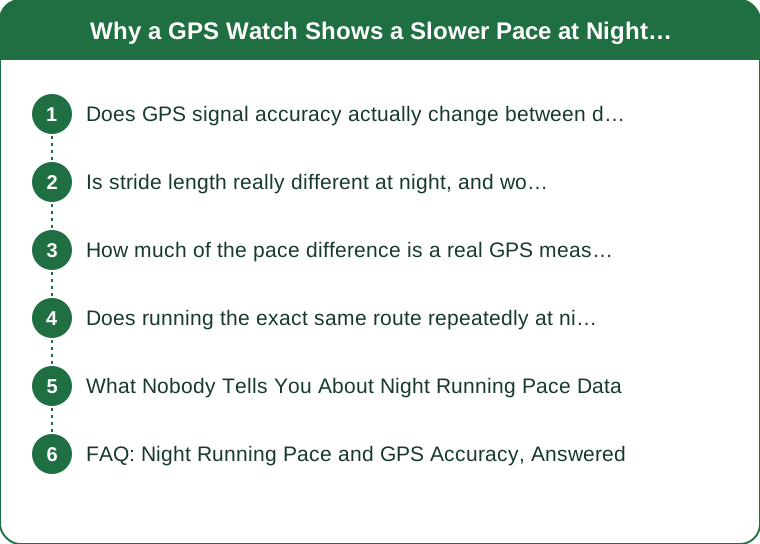
Does GPS signal accuracy actually change between day and night?
Not due to daylight itself, but environmental conditions correlated with nighttime running — colder temperatures affecting battery and signal processing, and often different satellite constellation positioning depending on time of day — can subtly affect GPS accuracy. The bigger nighttime accuracy factor is usually route-related rather than time-related: reduced ambient light doesn’t directly affect satellite signals, but routes commonly run at night (near tall buildings, under tree cover) can create the same signal-blocking issues regardless of time of day.
Is stride length really different at night, and would that meaningfully affect recorded pace?
Yes — reduced visibility naturally leads to a shorter, more cautious stride as the body unconsciously adjusts for less certainty about upcoming terrain, even on a familiar route. A measurably shorter stride at the same turnover rate directly translates into a genuinely slower actual pace, not just a slower recorded one, which means part of this effect is a real physiological adaptation, not purely a GPS artifact.
How much of the pace difference is a real GPS measurement issue versus a real behavior change?
Both contribute, and disentangling them fully requires more precise tools than a standard GPS watch, but a shorter, more cautious nighttime stride is a well-documented and significant factor on its own, independent of any GPS signal quality issue. This means even a hypothetically perfect GPS signal at night would likely still show a somewhat slower pace, purely from the real stride adaptation.

Does running the exact same route repeatedly at night versus day reveal a consistent gap?
Often yes — runners who track pace carefully on a familiar, well-lit route run at both times frequently report a small but consistent pace gap between day and night versions of the same run, supporting that this is a real, repeatable pattern rather than random measurement noise. The gap tends to be more pronounced on less familiar or less well-lit routes, consistent with the visibility-driven stride explanation.
What Nobody Tells You About Night Running Pace Data
Comparing night and day pace data directly is a less useful metric than tracking perceived effort and heart rate consistency across both conditions, since the underlying training stimulus (how hard the body is actually working) can be very similar even when the recorded pace numbers differ — treating night runs as a separate pace category, rather than directly comparable to daytime pace, avoids unnecessary frustration over a gap that has real explanations.
FAQ: Night Running Pace and GPS Accuracy, Answered
Should night run pace data be excluded from pace progression tracking?
Not excluded entirely, but tracked separately or with awareness of the expected gap avoids misinterpreting a normal night-run pace dip as an actual fitness regression.
Does running with a headlamp or better lighting reduce this pace gap?
Often somewhat, yes — improved visibility of the immediate path ahead tends to restore some of the natural stride length that shortens under reduced visibility, narrowing though not fully eliminating the gap.
Is heart rate a more reliable effort measure than pace for night runs specifically?
Yes, generally — heart rate reflects actual physiological effort independent of GPS accuracy or stride length changes, making it a more consistent metric for comparing night and day run intensity fairly.
TL;DR:
- GPS signal quality can be subtly affected by route conditions common to night running, not darkness itself
- Reduced visibility genuinely shortens stride length, which is a real, not just recorded, pace difference
- The night-versus-day pace gap is a repeatable, well-documented pattern with real underlying explanations
- Heart rate and perceived effort are more reliable ways to compare night and day run intensity than pace alone
A slower GPS pace on a night run isn’t necessarily a sign of reduced fitness — it’s usually a combination of real visibility-driven stride changes and route-related GPS factors, both of which have straightforward explanations.
Keep Reading
This article is for general informational and styling purposes only. Fit, sizing, and product availability may vary.