What to Eat Before a Night Run When Dinner Keeps Getting in the Way
Quick Answer: The evening runner’s food math has three workable patterns: run-then-dine (a 150-to-250-calorie carb snack 30 to 60 minutes before the run, real dinner after — the gold standard), the split dinner (half the meal two hours before, the rest after), or the full-dinner wait (a normal meal, then 2.5 to 3 hours before running — honest but schedule-hostile). What fails is improvising: running at 8pm on a 6:30 full dinner, or on nothing since lunch. Pick the pattern that matches your household’s dinner reality, and let easily digested carbs — banana, toast with honey, rice cakes, a small smoothie — do the pre-run work.
The morning runner’s fueling advice — just go, or grab half a banana — does not survive contact with 7pm. By evening you are eight hours from lunch, dinner is either looming or digesting, and the run has to thread between a bonk and a stitch. The gap between those two failures is narrower at night, but it is wide enough to run through every single evening once you stop winging it.

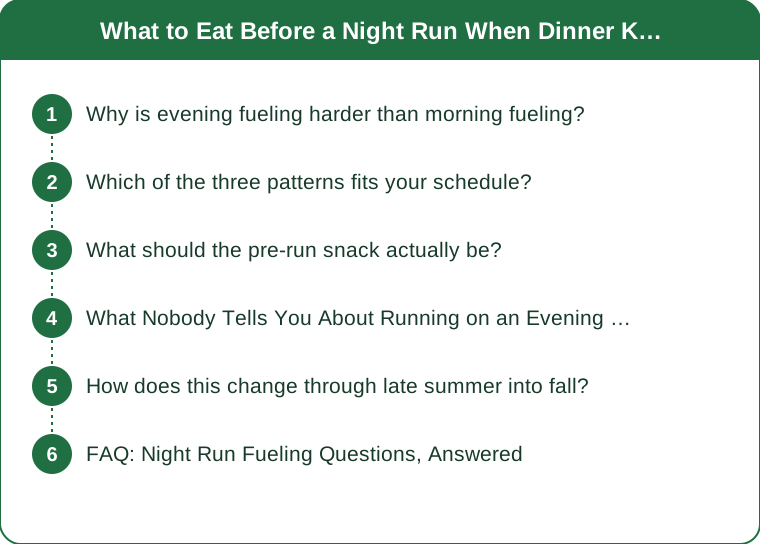
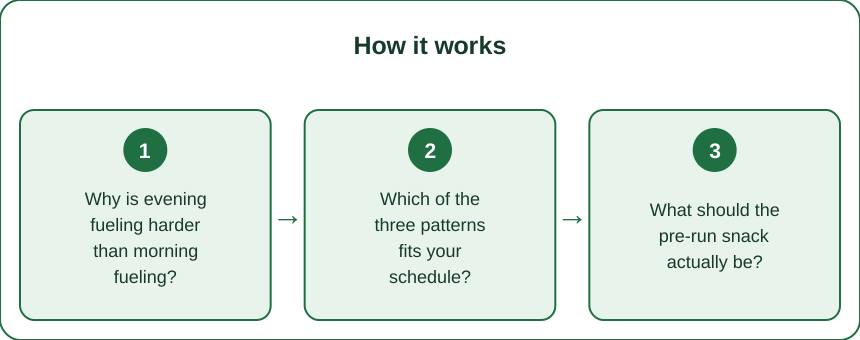
Why is evening fueling harder than morning fueling?
Because you arrive at the start line in a completely different metabolic state.
A morning runner starts on a 10-hour fast with full-ish glycogen — the liver is low but muscles are stocked from yesterday’s meals, so short easy runs work on empty. An evening runner starts six to nine hours after lunch: blood sugar is drifting at its afternoon low, liver glycogen is partially spent from the day, and the last meal is a memory. Run on that and the tank warning arrives mid-run as heavy legs, a pace that will not come, and the peculiar low-fuel crankiness every evening runner has met at kilometer four.
Overcorrect with a full dinner at 6:30 and an 7:15 start, and the opposite failure appears. Digestion and running compete for the same blood supply; a full stomach mid-run means sloshing, side stitches, reflux on hills, and in the worst cases the emergency walk home. A real mixed meal — protein, fat, fiber — takes two to three hours to clear the stomach far enough to run comfortably, and the fattier the dinner the longer the wait.
The evening slot also stacks a hidden variable: the day’s hydration debt. Most people drift under-hydrated from lunch onward, and an evening run in late-summer heat starts from that deficit — part of why the same route feels harder at 7pm in August than the numbers say it should.
So evening fueling is a two-sided constraint: enough recent carbohydrate to run well, little enough recent food to run comfortably. Three patterns thread it.
Which of the three patterns fits your schedule?
Match the pattern to your dinner reality, not to an ideal.
Pattern one: snack-run-dinner. The 30-to-60-minute pre-run snack (next section), the run, then dinner as recovery meal. This is the physiological winner — you run light but fueled, and dinner lands in the post-run window when your body is primed to restock. It suits anyone whose household can eat at 8 or 8:30, and it makes dinner taste spectacular. Its one risk: the post-run appetite either vanishes or arrives as a bear; have dinner planned or prepped before you leave so the bear does not order pizza.
Pattern two: the split dinner. Eat the carb-forward half of dinner about two hours before the run — rice, pasta, bread, fruit, some lean protein — and save the rich half (the salmon, the dressing-heavy salad, dessert) for after. This fits family tables that eat at 6 sharp: you sit with everyone, eat strategically, run at 8, finish the meal after. It requires nothing but plating discipline.
Pattern three: full dinner, full wait. A normal dinner, then 2.5 to 3 hours before an easy run — fine on paper, but 6:30 dinner puts you on the road at 9:15, which is a bedtime negotiation. It works best for naturally late households and short easy runs, where the wait can shave toward two hours.
Across all three, intensity moves the clock: easy conversational runs tolerate more recent food; tempo work and intervals want the emptier stomach of pattern one, with the snack at the early end of its window.
What should the pre-run snack actually be?
Small, carb-dominant, low-fiber, low-fat — the four rules that cover every good option.
The job is topping up blood glucose and liver glycogen without giving the stomach a project. That means 150 to 250 calories, mostly carbohydrate, 30 to 60 minutes out:
- A banana — the archetype for a reason: fast carbs, potassium, zero prep.
- White toast or half a bagel with honey or jam — white beats whole-grain here; this is the one meal where fiber works against you.
- Rice cakes with a thin scrape of nut butter — thin, because fat slows the clock.
- Applesauce pouch or a handful of pretzels — the travel-and-desk options.
- A small fruit smoothie — doubles as hydration, sits light for most stomachs.
- Half a granola bar of the low-fiber persuasion, if the drawer is the only store open.
Skip within two hours of an evening run: big salads and raw-vegetable bowls, bean-heavy anything, fried food, creamy sauces, and carbonated drinks — the complete gastrointestinal incident report of evening running, respectively fiber, fiber, fat, fat, and gas.
Coffee deserves its evening-specific note: the pre-run espresso that works at 7am is a sleep tax at 7pm. If you want a lift, take it before 2pm or accept the trade knowingly; caffeine’s half-life does not care about your race calendar.
And add 300 to 500ml of water across the pre-run hour — sipped, not chugged — with a pinch of salt or electrolyte tab on the sweatier late-summer evenings, which quietly repays the afternoon’s hydration debt before the road collects it.

What Nobody Tells You About Running on an Evening Stomach
The afternoon writes the evening run more than the pre-run snack does. A 3pm protein-plus-carb snack — yogurt and fruit, cheese and crackers — is the single highest-leverage change for evening runners, because it shortens the lunch-to-run fast from seven hours to four and lets the pre-run snack be genuinely small. Runners who fix the afternoon routinely discover their “sensitive stomach” was actually an empty one overcorrected at 6:45.
The post-run non-appetite is real and temporary: hard evening efforts suppress hunger hormones for 30 to 60 minutes, exactly when dinner is served. Eat anyway, at least modestly — skipping dinner after a night run under-fuels tomorrow and correlates with the 10pm cabinet raid when appetite comes roaring back. A smaller plate immediately plus a yogurt before bed beats heroic abstinence followed by cereal at midnight.
Reflux runs worse at night for boring mechanical reasons — a fuller stomach, then lying down within a couple of hours. If evening runs bring heartburn that morning runs never did, the levers are the snack-not-meal pattern, tomato-and-citrus-light pre-run choices, and 90 minutes of vertical time between the run, the dinner, and the pillow.
And the sleep interaction cuts both ways: finishing hard intervals at 9pm can push sleep later (body temperature and adrenaline need an hour-plus to descend — a cool shower and the fan help), while easy evening runs reliably deepen sleep. Match the intensity to the bedtime, not just the training plan; an easy run that protects sleep beats the tempo session that costs it, most weeks of an ordinary life.
How does this change through late summer into fall?
The evening window is moving — and the fueling moves with it.
Right now the equation is heat-dominated: an August 7pm run can start above 85F, which elevates fluid needs, suppresses pre-run appetite (favoring the smoothie and applesauce end of the snack list), and argues for the latest start the daylight allows. The salt pinch in the pre-run water earns its keep most in these weeks, and so does the post-run electrolyte glass ahead of dinner.
Over the next six to eight weeks, the trade flips: evenings cool into perfect running weather while the light contracts — the 8pm golden-hour run becomes a 7:15 dusk run becomes a headlamp run. The fueling consequence is subtle but real: cooler evenings restore pre-run appetite, tolerate the split-dinner pattern better (a slightly fuller stomach bothers a 65F run less than an 85F one), and shift hydration from urgent to routine.
The schedule consequence is bigger: as the window tightens, the snack-run-dinner pattern gets structurally better — run at first-dark, dinner after — while the full-dinner-wait pattern collapses entirely, because 9:15 starts stop being warm or lit. Runners who lock pattern one in September keep their routine through the clock change; pattern-three runners tend to discover in October that their run quietly disappeared.
Worth pairing with the fueling shift: the reflective-gear audit belongs to these exact weeks, and warmer layers change nothing about the stomach math — the banana works in every temperature the season will offer.
FAQ: Night Run Fueling Questions, Answered
Can I just run fasted in the evening like I do in the morning?
Morning “fasted” is ten hours from dinner with restocked muscle glycogen; evening “fasted” is seven-plus hours from lunch with a day’s activity spent — metabolically much emptier. Easy 20-to-30-minute evening runs tolerate it; anything longer or harder degrades noticeably. The banana costs 90 seconds and upgrades the whole session.
How long exactly should I wait after a full dinner?
The honest range is 2.5 to 3 hours for a mixed meal before comfortable running, shading toward 2 for small low-fat dinners and easy paces, and toward 3-plus for rich meals or interval nights. Individual variance is real — test on easy runs, and let your own stitch history set the number, not the internet’s.
What about eating during a long evening run?
Runs past 75 to 90 minutes follow normal long-run rules regardless of the hour — 30 to 60 grams of carbs per hour from gels or chews — with the evening-specific note that caffeinated gels late at night will bill your sleep. For the common 45-to-60-minute evening run, nothing mid-run is needed if the pre-run pattern was followed.
Is it bad to eat a big dinner right after a hard night run?
It is close to ideal — the post-exercise window is exactly when your muscles restock fastest, and dinner-as-recovery-meal is the snack-run-dinner pattern’s whole design. The only adjustments: lead with fluids, include real carbohydrate and 25-plus grams of protein, and keep the truly enormous, very-late version in check for reflux and sleep reasons — a normal dinner at 8:45 beats a feast at 9:30.
TL;DR:
- Evening runs start metabolically empty but often digestively full — the fix is choosing a pattern: snack-run-dinner (best), split dinner (most family-compatible), or full-dinner-plus-3-hours (honest but late).
- The pre-run snack formula: 150 to 250 calories of low-fiber, low-fat carbs — banana, white toast with honey, rice cakes — 30 to 60 minutes out, with 300 to 500ml of water.
- A 3pm protein-carb snack is the hidden lever that fixes most evening stomach and bonk problems before 6pm arrives.
- Eat dinner after the run even when appetite is suppressed, keep late caffeine out of the equation, and lock in the snack-run-dinner pattern before the daylight window tightens.
Pick your pattern tonight, put a banana where the car keys live, and run the experiment for two weeks. The evening runner’s stomach was never the problem — the improvising was.
Keep Reading
This article is for general informational and styling purposes only. Fit, sizing, and product availability may vary.