The Difference Between Actually Being Visible at Night and Just Feeling Visible
Quick Answer: Feeling visible at night and being visible are different things. You judge visibility from a lit sidewalk standing still; a driver judges it through a windshield at 40 mph. Research consistently finds drivers detect night runners much later than runners assume. Reflective material on moving limbs — ankles and wrists — outperforms a static vest.
You’ve got the light-colored top, the headlamp, and a sense that drivers can obviously see you.
Now sit in a car on that same road at 8 p.m. and look for someone dressed exactly like you. The gap between those two experiences is the entire subject.

Why Doesn’t Feeling Visible Mean You Actually Are?
Because you and the driver are solving different visual problems from different positions.
Your vantage point flatters you. You’re standing under or near streetlights, looking at a lit environment, with your own headlamp illuminating everything nearby. Your subjective sense of “this area is well lit” is real — for you.
The driver’s vantage point doesn’t. They’re behind a windshield, at speed, with headlight glare, oncoming lights, and a visual field full of competing information. They’re not looking for you specifically. They’re scanning a lot of road.
And research on actual driver detection distance for night runners consistently finds considerably shorter real detection distances than runners themselves estimate. That gap is where the risk lives, because detection distance is what determines whether the driver has time to react at all.
Your headlamp is the sharpest version of this trap. It dramatically improves what you see. It does comparatively little to make you visible from behind or the side — which is where most of the danger comes from.
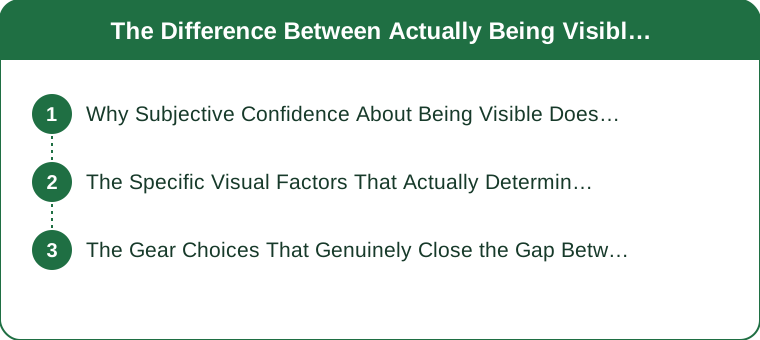
What Actually Determines Whether a Driver Sees You?
Three factors, and only one of them is what most people optimize for.
1. Motion. This is the big one. Reflective elements on actively moving limbs — ankles and wrists — produce considerably greater real detection distance than static reflective material on the torso alone. Human visual systems are strongly tuned to detect biological motion. A pair of moving reflective ankles reads unmistakably as a person far sooner than a stationary bright rectangle reads as anything at all.
That’s the crucial insight: your ankles move through the largest arc, fastest, and closest to a driver’s eye line. They’re your highest-value real estate, and almost nobody uses them.
2. Contrast against the actual background. Not brightness in the abstract — contrast against what’s behind you on your route. White is excellent against dark trees and poor against a snowy verge or a lit storefront. Fluorescent yellow works well in dusk and dawn light, less so in full dark. The right color depends on the road you actually run.
3. Reflective vs. active lighting. Reflective material only returns light aimed at it, so it works when headlights hit it and does nothing before that. Active lights — small blinking LEDs — are visible independent of a driver’s headlights and from wider angles. They complement each other rather than substituting.

5 Mistakes Everyone Makes Running at Night
- Relying on a headlamp for visibility. It’s a seeing tool, not a being-seen tool.
- A reflective vest and nothing else. Static, torso-only, and it reads as an object rather than a person until you’re close.
- Assuming a bright color works after dark. Color needs light to be color. After full dark, an unlit bright shirt is a grey shape.
- Wearing dark leggings under a reflective top. The legs are the moving part. Covering the visible half in black wastes the best signal you have.
- Trusting the feeling. The third mistake surprises most runners, but this one is the root: subjective confidence has no relationship to detection distance.
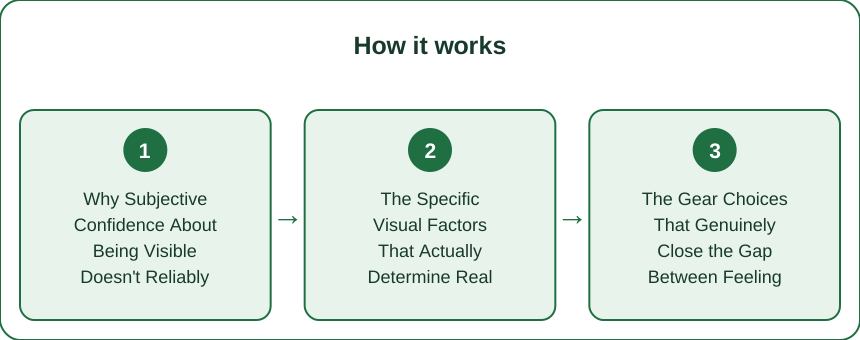
What Gear Actually Closes the Gap?
Put reflective material on your moving limbs first. Reflective ankle bands, reflective strips on your shoes, wrist bands. If you buy one thing, buy ankle reflectors — they’re cheap and they’re the highest-value item on the list.
Then add the vest or torso reflectivity, which gives a driver a larger target once they’ve registered motion. Order matters: limbs first, torso second.
Choose colors against your route’s actual background. Walk or drive your route once in the dark and look at what’s behind you at the sketchy points. Choose contrast for that, not for the shop display. Reflective detailing built into what you already wear helps here too — high waist running leggings with reflective strips down the leg put reflectivity exactly where the motion is, without adding a layer.
Add an active blinking light, front and back. Small, cheap, visible from wider angles, and independent of headlights.
Then test it — this is the step nobody does. Have someone drive your route at realistic speed under similar conditions and honestly report the point at which they first noticed you. That single test replaces every marketing claim and every subjective guess with an actual number for your actual gear on your actual road. Most people find it sobering, adjust their setup, and re-test.
Beyond gear: run facing traffic where practical, assume you haven’t been seen at intersections, and be conservative about headphone volume on roads without sidewalks.
FAQ
Is a reflective vest enough on its own?
It’s better than nothing and worse than most people assume. Static torso reflectivity lacks the motion signal that makes a driver register a human rather than an object. Add limb reflectors.
Do I need lights if I have reflective gear?
They do different jobs. Reflective material needs a driver’s headlights aimed at it; active lights are visible on their own and from wider angles. Use both.
Does a headlamp make me more visible to drivers?
Barely, and only from directly in front. It’s for seeing the road surface, not for being seen — treat it as a separate problem from visibility.
TL;DR
- Your sense of being visible comes from a flattering vantage point. Drivers detect night runners far later than runners assume.
- Motion is the strongest signal — reflective material on ankles and wrists beats a static torso vest.
- Contrast against your actual route’s background matters more than abstract brightness.
- Use reflective material and active blinking lights together — they work in different conditions.
- Test it: have someone drive past at real speed and report when they first saw you.
Keep Reading
This article is for general informational and styling purposes only. Fit, sizing, and product availability may vary.