How to Start Running at Night (Safe, Comfortable and Consistent)
Quick Answer: Night running is safe and often better than morning running — body temperature, muscle flexibility, and reaction time all peak in the late afternoon and evening. The three non-negotiables: be visible (a reflective vest plus a front and rear light, not just dark clothes with a stripe), run lit, familiar routes, and tell someone your route and expected return time. Finish at least 90 minutes before bed so your body temperature has time to drop.
For a lot of people, evening isn’t the preferred time to run. It’s the only time.
Good news: it’s genuinely a good time to run. Not a compromise, not a consolation prize. Your body is measurably better at running in the evening than it was at 6am — the reasons are below. What evening running does require is a bit more deliberate thought about visibility and route, and that’s mostly a one-time setup cost.

Is It Better to Run at Night?
For performance, often yes.
Your core body temperature peaks in the late afternoon and early evening — typically 4pm to 8pm — and warmer muscles are more pliable, which means better range of motion and a lower injury risk than running cold at dawn. Reaction time, grip strength, and perceived exertion all tend to favor evening too. Studies on circadian rhythm and athletic performance consistently find that most physical performance markers peak in this window.
Practical advantages stack on top:
- It’s cooler. In summer, the difference between a 6pm run and an 8:30pm run can be 10–15°F.
- The paths are empty. Fewer people, fewer dogs, fewer strollers.
- It genuinely decompresses the day. A run that separates work from home is doing two jobs at once.
- You’ve eaten. Morning runners are running on 10 hours of fasting; you’re not.
The one real trade-off is sleep, and it’s manageable — see below.
How to Run at Night Safely
Six things, and the first one is not optional.
1. Be properly visible — this is the whole ballgame.
The mistake almost everyone makes: assuming that a reflective logo on a jacket is enough. It isn’t. Reflective material only works when headlights hit it directly, and it does nothing at all from the side.
What actually works:
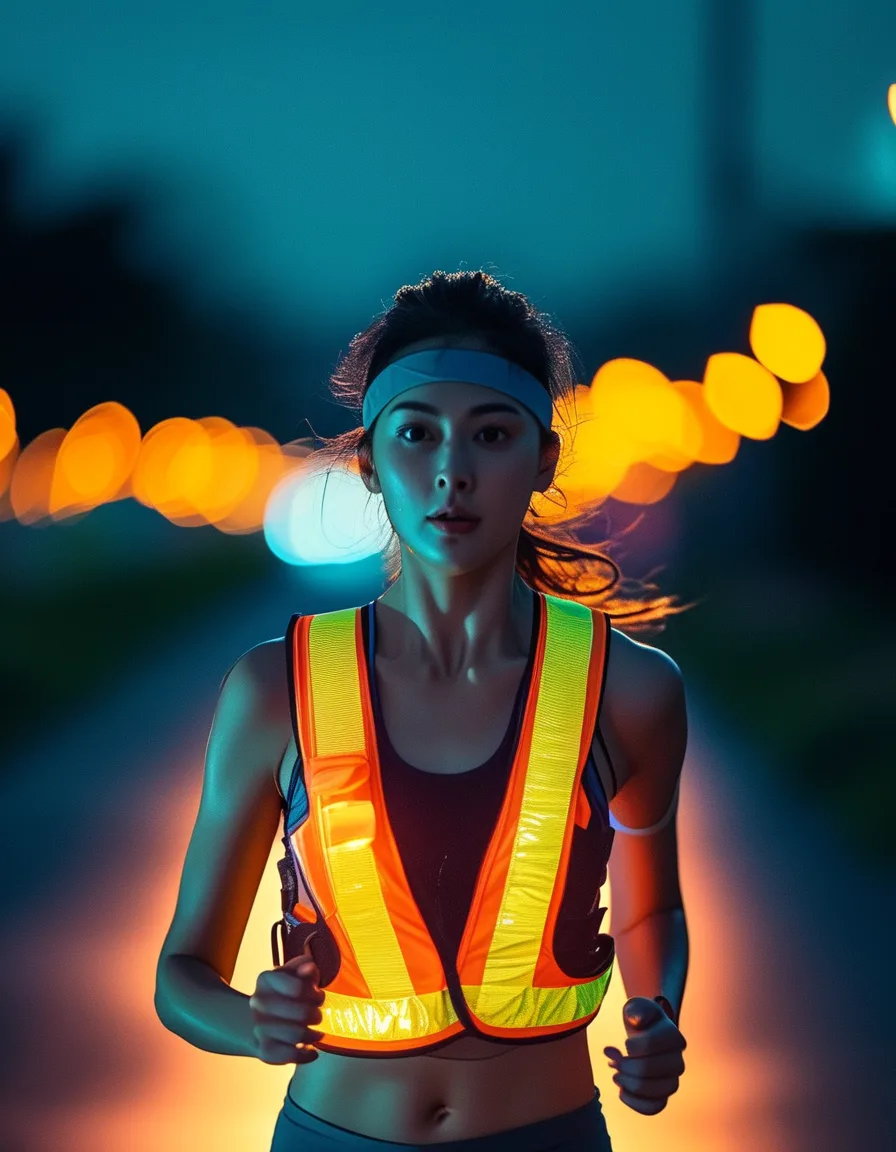
- A reflective vest. $15–25, goes over anything, visible from 500+ feet in headlights. This is the single highest-value purchase in night running.
- A rear red blinking light clipped to your waistband. Cars approaching from behind are the real risk.
- A front white light — either a headlamp or a chest light. This lets you see the ground and be seen by oncoming traffic.
- Light-colored clothing as a base. Black leggings are fine if the vest and lights are doing their job, but a light top helps.
Total setup cost: about $40–60, once.
2. Run lit, familiar routes. Know where the potholes and uneven pavement are. Ankle injuries are the most common night-running injury, and they come from ground you can’t see.
3. Tell someone. Route and expected return time. Or use a live-location share — most phones and running apps have this built in, and it takes ten seconds.
4. Keep one ear open. If you run with headphones, use bone conduction or keep one earbud out. You need to hear cars, bikes, and people.
5. Carry a phone and ID. A road ID bracelet or an ICE contact in your phone is worth setting up.
6. Trust your instincts. If a route or a person feels off, turn around. Nobody’s run is worth talking yourself out of an instinct.
Will Running at Night Ruin Your Sleep?
Probably not — but timing matters.
Exercise raises your core temperature and your heart rate, and falling asleep requires both to drop. The general guidance is to finish at least 90 minutes before bed, which gives your body time to cool down.
Two useful caveats:
- Intensity matters more than timing. An easy 30-minute jog at 9pm affects most people’s sleep far less than intervals at 7pm. If you’re running late, run easy.
- Individual variation is large. Research on evening exercise and sleep is genuinely mixed, with plenty of studies finding no negative effect at all. Some people sleep better after an evening run. Test it for two weeks and see which group you’re in rather than assuming.
If it is disrupting your sleep: move the run 30–60 minutes earlier, take a warm shower afterward (counterintuitively, this accelerates cooling), and keep the last 10 minutes of the run as a genuine cool-down walk.
Making It a Habit That Sticks
Evening habits face one enemy that morning habits don’t: the whole day gets to talk you out of it.
Five things that meaningfully improve the odds:
- Fix the time, not the run. “Tuesday and Thursday at 7:30” is a habit. “Sometime in the evening, 3 times a week” is a wish.
- Lay everything out before work. Shoes, vest, lights charged, kit by the door. The decision you’re avoiding at 7pm is usually “find my stuff,” not “go running.”
- Use one repeatable route. Decision fatigue is real at the end of a day. A default 5km loop you don’t have to think about removes the last excuse.
- Frame it as the wind-down, not the workout. The run that ends the workday is much easier to keep than the run that’s another item on the to-do list.
- Keep it easy. Most of your evening runs should be conversational pace. Consistency at easy effort beats occasional hard sessions that leave you dreading the next one.
Charge your lights on a schedule. Sunday night, everything on the charger. A dead headlamp on Wednesday is how a habit gets skipped.
What Nobody Tells You About Night Running
- The first-mile temperature lie. You’ll feel cold for the first five minutes and then be too warm. Dress for 10°F warmer than it is.
- Your pace will be faster and it’ll feel easier. Warm muscles plus cooler air is a genuinely favorable combination. Don’t be surprised by an evening PR.
- Bugs are the underrated evening hazard in summer. A hat brim helps more than you’d think.
- Reflective gear works from the front and behind, not the side. This is why intersections are the highest-risk moment of any night run. Assume drivers turning across your path haven’t seen you until you make eye contact.
- Dogs and wildlife react differently at night. Give both more space than you would in daylight.
When to see a professional: if you’re new to running entirely, build up gradually — a walk/run progression over 6–8 weeks — and check with a doctor first if you have a cardiovascular condition, a joint injury, or you’ve been sedentary for a long time.
Mini FAQ
What should you wear for running at night?
A reflective vest over whatever you’d normally wear, a rear red blinking light, and a front white light or headlamp. Reflective trim on clothing alone is not sufficient — it only works when headlights hit it directly. Add a light-colored top if you have one; total setup runs about $40–60.
Is it safe to run alone at night?
It can be, with precautions: stick to well-lit familiar routes, tell someone your route and return time, keep one ear free of headphones, carry a phone and ID, and vary your timing if you run the same route regularly. Many runners feel more comfortable joining an evening run club — most cities have several, and they’re usually free.
How late is too late to run?
Aim to finish at least 90 minutes before bed so your core temperature can drop. If you can only run later than that, keep the effort easy and add a proper cool-down. Some people are genuinely unaffected by late running — test it for two weeks and judge from your own sleep, not from general advice.
TL;DR
- Evening is a genuinely good time to run — body temperature, flexibility, and reaction time all peak in the late afternoon.
- Visibility is the whole safety story: reflective vest + rear red light + front white light. About $40–60, once.
- Lit, familiar routes. Ankle injuries come from ground you can’t see.
- Tell someone, keep one ear open, carry phone and ID.
- Finish 90 minutes before bed, and keep late runs easy.
- Lay out your gear in the morning. The evening excuse is usually “where’s my stuff.”
Set the visibility kit up once, pick one route, and evening running stops being the compromise option.
Keep Reading
This article is for general informational and styling purposes only. Fit, sizing, and product availability may vary.