How to Pick a Genuinely Safe Night Running Route
Quick Answer: Prioritize routes with consistent street lighting, moderate foot or vehicle traffic (not deserted, but not high-speed roads either), and cell coverage over routes chosen just for scenery or distance — the safest night route is rarely the most scenic one.

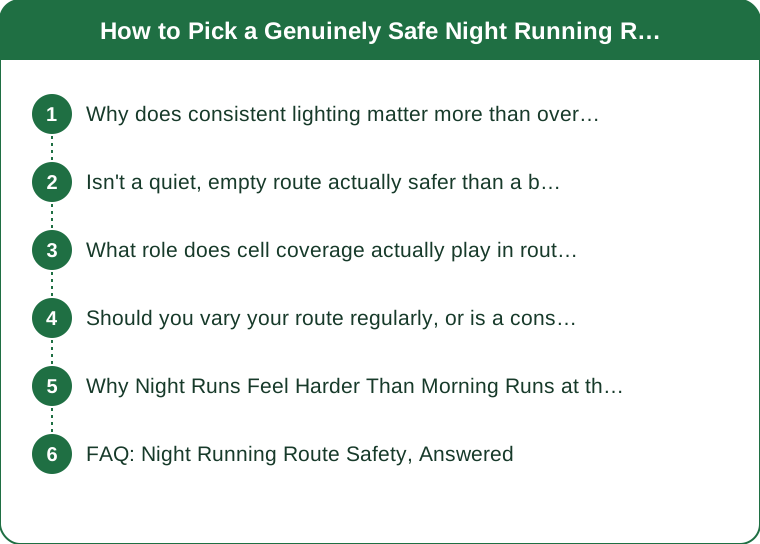
Why does consistent lighting matter more than overall route length or terrain?
Gaps in lighting create blind spots for both your own footing and other people’s ability to see you, which is a bigger practical safety factor at night than hills or surface type. A well-lit 3-mile loop is a safer choice than a scenic but poorly-lit 5-mile route, even if the second is more appealing in daylight.
Isn’t a quiet, empty route actually safer than a busier one?
Not necessarily — completely deserted routes remove the safety benefit of other people being nearby if something goes wrong, while a moderately trafficked route (other walkers, joggers, or slow local traffic) provides some passive safety through visibility and presence, without the risk of high-speed roads.
What role does cell coverage actually play in route selection?
It’s an easy factor to overlook until it matters — some parks, trails, or underpasses have known dead zones for cell service, which becomes a real problem if you need to call for help or use a safety app’s location sharing. Checking coverage maps or simply testing your phone on a route in daylight first is worth the extra step.

Should you vary your route regularly, or is a consistent route safer?
A mostly-consistent route lets you learn the specific safety details (lighting gaps, uneven pavement, typical foot traffic) that a completely new route each time doesn’t offer, but varying your exact timing and occasionally the route itself avoids becoming too predictable to someone who might be paying unwanted attention.
Why Night Runs Feel Harder Than Morning Runs at the Same Pace
Separate from safety, it’s worth knowing: reduced visual input at night increases perceived effort even at an identical pace and heart rate to a daytime run, since your brain relies partly on visual flow to judge how fast you’re moving. This is normal and not a sign of declining fitness.
FAQ: Night Running Route Safety, Answered
Is running with headphones ever actually safe at night?
Bone-conduction headphones or keeping one ear free is generally safer than fully sealed earbuds, since situational awareness of approaching traffic or people matters more at night than during the day.
Should you tell someone your route before a night run?
Yes, this is one of the simplest and most effective safety steps — sharing your planned route and expected return time with someone takes seconds and provides a real safety backstop.
How do you find well-lit routes in an unfamiliar area?
Mapping apps with street view, local running club route recommendations, and simply driving or walking a route once in daylight before running it at night are all reliable ways to vet an unfamiliar route.
TL;DR:
- Consistent lighting matters more for safety than scenery or route length
- Moderate foot traffic beats both deserted routes and high-speed roads
- Check cell coverage on your route before you actually need it
- A mostly-consistent route lets you learn its specific safety details over time
The safest night route is usually the boring, well-lit, moderately busy one — not the scenic loop that looks better on a map.
Keep Reading
This article is for general informational and styling purposes only. Fit, sizing, and product availability may vary.